BPC-157 Wholesale Canada: Research Background and Sourcing Notes
BPC-157 for research in Canada: what the preclinical literature reports, how the peptide is characterized and what wholesale buyers should check.
BPC-157 is one of the most requested research peptides in Canada, and one of the most misrepresented. It is a research compound with a substantial body of preclinical literature, mostly from animal models, and very little controlled human data. This article summarizes what the published research reports, where the compound stands with regulators, and what buyers sourcing it in volume should check.
What BPC-157 is
BPC-157 is a synthetic pentadecapeptide, a chain of fifteen amino acids. Its sequence was derived from a protein found in gastric juice, hence the name "body protection compound." It is typically supplied as a lyophilized powder with a molecular weight of roughly 1,419 daltons. Because it is a short, defined sequence, it can be made by standard solid-phase synthesis and characterized by HPLC and mass spectrometry like any other research peptide.
What the published research reports
Most BPC-157 research comes from a small number of groups, particularly the laboratory of Predrag Sikiric at the University of Zagreb, and most studies use rodent models. Findings in rats are hypotheses for further study, not evidence of effects in people.
Tendon and soft tissue models
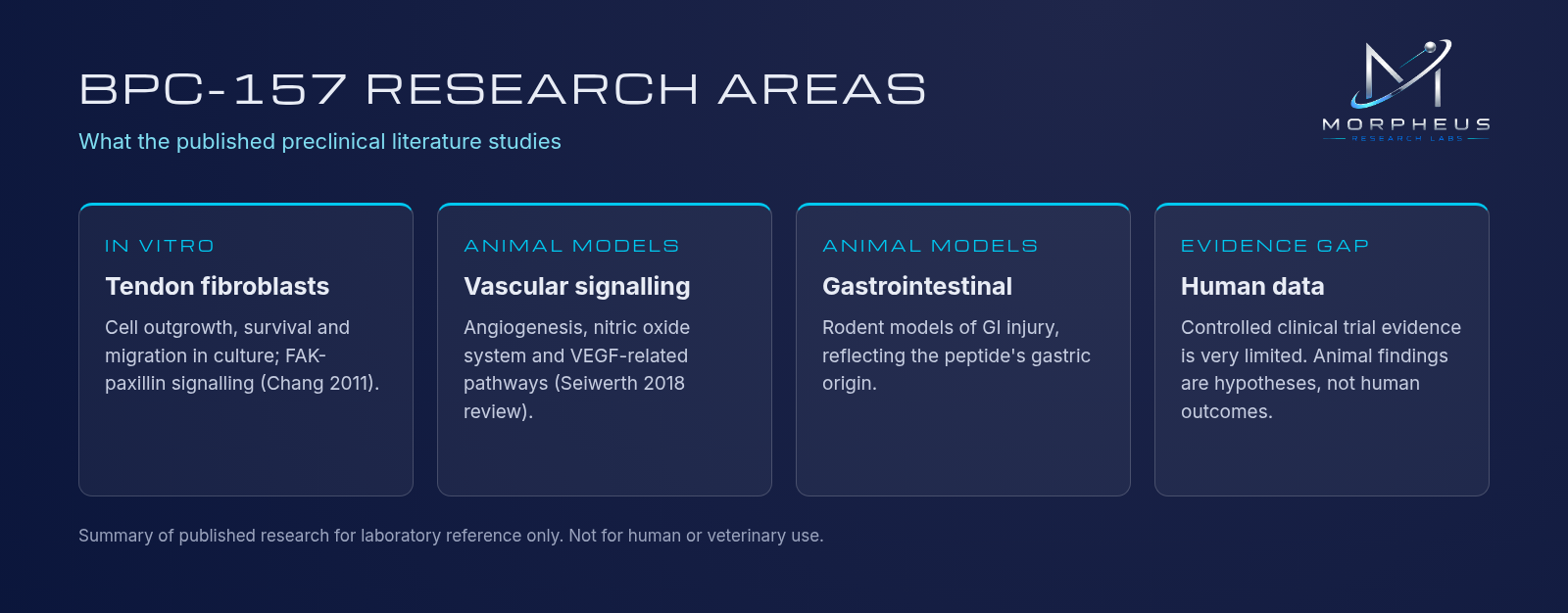
A frequently cited study by Chang and colleagues in the Journal of Applied Physiology (2011) examined rat tendon fibroblasts in culture. The authors reported increased outgrowth, survival under stress and migration of the cells, and linked the migration effect to activation of the FAK-paxillin signalling pathway. It was an in vitro study and is usually cited as a mechanistic starting point.
Angiogenesis and blood vessel signalling
A review by Seiwerth and colleagues in Current Pharmaceutical Design (2018) discussed BPC-157 alongside standard angiogenic growth factors, summarizing animal research on its interactions with vascular signalling, including the nitric oxide system and VEGF-related pathways. The review draws heavily on the same research group's work.
Gastrointestinal models
Given its origin, much of the literature studies BPC-157 in rodent models of gastrointestinal injury, reporting tissue-level outcomes in animals. These remain preclinical.
Human data
Controlled clinical trial evidence for BPC-157 is very limited. Be wary of any source that presents animal findings as established human outcomes.
Reading the literature critically
When reviewing papers, check the injury model and its timing, the route and vehicle used in animals (not interchangeable across studies), what the outcome measures actually capture, whether assessment was blinded with matched vehicle controls, and whether results have been replicated by independent groups. New work adds most value when it reports the supplier, lot, stated purity and identity confirmation of the material used.
Regulatory status
BPC-157 is not an approved drug in any major market. A few points matter for anyone sourcing or writing about it:
- Canada. Health Canada has not authorized BPC-157 for sale as a drug, and lists it among unauthorized peptide products in its public advisories.
- Sport. The World Anti-Doping Agency named BPC-157 on its Prohibited List from 2022, under S0 (Non-Approved Substances), prohibited at all times.
- United States. The FDA lists BPC-157 in Category 2 of bulk drug substances nominated for compounding, the group it identified as potentially presenting significant safety risks. In October 2026, HHS announced a draft enforcement-discretion policy covering compounding of BPC-157 and several other peptides under set conditions; HHS states this is not FDA approval.
Morpheus Research supplies BPC-157 for laboratory research only. Nothing here is guidance on human use.
BPC-157 in blends
BPC-157 is often supplied with TB-500, a synthetic fragment related to thymosin beta-4, so researchers can study both from one vial. Morpheus Research lists blended formats including BPC-157/TB-500 20mg and BPC 10mg / TB-500 10mg. Our article on BPC-157 and TB-500 blends covers the thymosin beta-4 literature.
Blends need extra documentation. A certificate should confirm the identity of both peptides by mass, and ideally the content of each, since a blend with an uneven ratio is a different research material.
Sourcing BPC-157 in volume
Because BPC-157 is so popular, supply quality varies widely. Wholesale buyers should insist on batch-specific certificates with HPLC purity and mass spectrometry identity from an independent lab, lot numbers that match between vials and certificates, content data (particularly for blends), consistent fill sizes across a batch, and clear storage and packing for shipment.
Choosing a format. Single-compound vials suit researchers studying BPC-157 alone, and smaller fills reduce waste in short pilots, since a vial's usable life starts at reconstitution. Blended vials give a fixed ratio but less flexibility: studies that need single-compound control arms will need separate vials.
Lot planning. For studies running several weeks, buy enough from one lot at the start rather than topping up from a different lot later. Ask how much of the current lot is available, and qualify a second supplier as a safeguard.
How Morpheus tests every lot
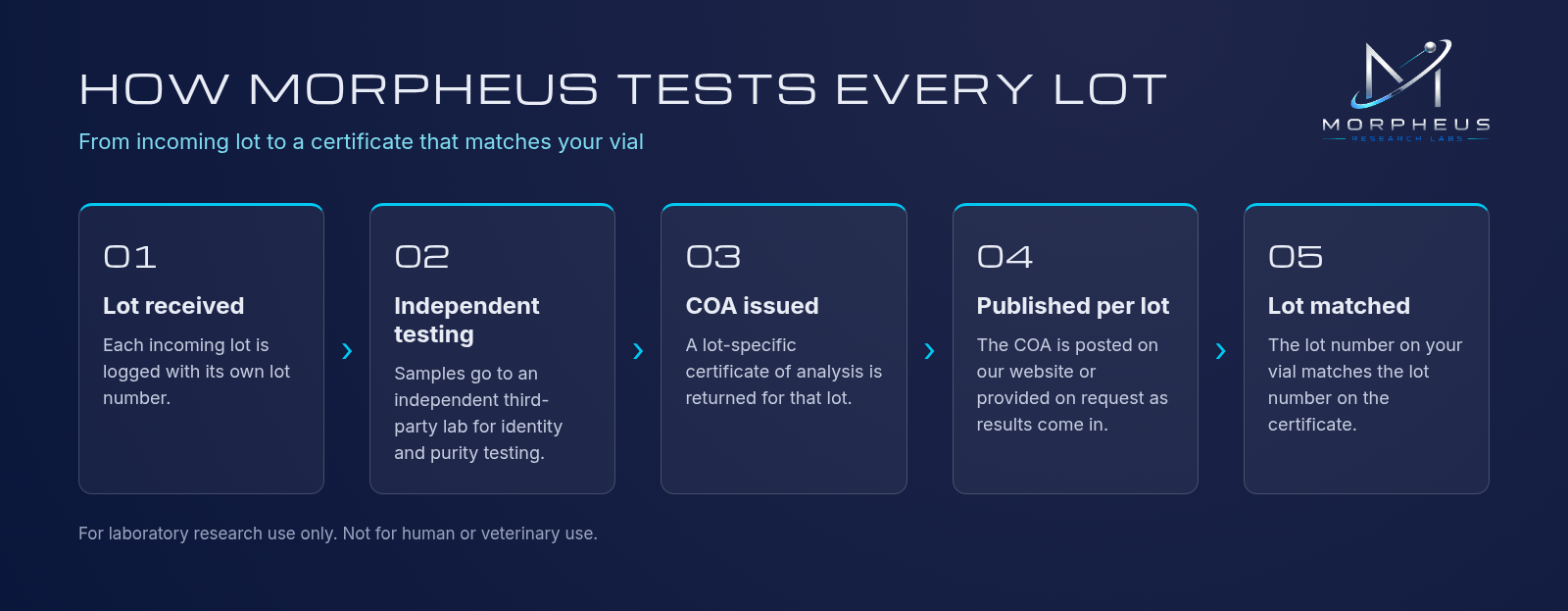
We don't rely on supplier paperwork alone. Every lot of material we sell is sent to an independent third-party laboratory for identity and purity testing, separate from any testing by the manufacturer. As results come in, we publish the lot-specific certificate of analysis on our website, or provide it on request, so the lot number on your vial matches the lot number on the certificate. Testing for our current lots is underway, and certificates are posted per lot as each result is returned. Our guide to reading a peptide COA explains what each section of a certificate shows.
Handling notes for the lab
BPC-157 is supplied lyophilized and commonly stored cold, dry and protected from light before reconstitution. Labs typically reconstitute with a sterile diluent such as bacteriostatic water according to their own procedures, keep the solution refrigerated and use it within a defined period. The literature describes BPC-157 as relatively stable compared with many peptides, but those claims refer to specific conditions: follow a written procedure and avoid repeated freeze-thaw cycles. Our guides on peptide storage and reconstitution cover general practice.
Writing about BPC-157 responsibly
If you resell or publish about BPC-157, tie claims to specific studies and models. "A 2011 in vitro study reported increased tendon fibroblast migration" is accurate. "BPC-157 heals tendons" is not, and that wording is what gets research businesses removed from payment platforms.
Frequently asked questions
Is BPC-157 approved for human use in Canada? No. Health Canada has not authorized it as a drug. Morpheus Research sells it strictly as a research compound.
What does the research show? Published work, mostly in rodents and cell culture, reports effects on tissue-repair-related signalling and angiogenesis in those models. Controlled human data is very limited.
What should a BPC-157 COA include? HPLC purity, mass spectrometry identity, lot number, test date and the testing lab's name. For blends, confirmation of both components.
Where can Canadian labs source BPC-157 wholesale? Look for a supplier with lot-matched, independently tested certificates and Canadian shipping. See our wholesale details below.
Wholesale BPC-157 for Canadian research buyers
Morpheus Research supplies BPC-157, single and blended, to research labs, the research arms of clinics and institutions, and resellers across Canada. Wholesale buyers get consistent lots, a lot number on every vial, batch documentation with each order and shipping within Canada. Volume pricing is available on request.
If you plan to sell under your own brand, read our white-label reseller guide first. Then send your compound list, formats, quantities and province through our contact page, and we will reply with wholesale pricing, current lot availability and the documentation that comes with it. You can also browse the full range in our shop.
Related reading
- Peptide COA Explained: How to Read a Certificate of Analysis
- How to Store Research Peptides: Lyophilized and Reconstituted Handling
- Peptide Reconstitution with Bacteriostatic Water: A Lab Handling Guide
- BPC-157 and TB-500 Blends: What the Research Literature Reports
- Research Peptides in Canada: A Practical Buyer's Guide for Labs
References
- Chang CH, Tsai WC, Lin MS, Hsu YH, Pang JH. The promoting effect of pentadecapeptide BPC 157 on tendon healing involves tendon outgrowth, cell survival, and cell migration. J Appl Physiol. 2011;110(3):774-780. PMID: 21030672.
- Seiwerth S, Rucman R, Turkovic B, et al. BPC 157 and standard angiogenic growth factors. Gastrointestinal tract healing, lessons from tendon, ligament, muscle and bone healing. Curr Pharm Des. 2018;24(18):1972-1989. PMID: 29998800.
- World Anti-Doping Agency. The 2022 Prohibited List, S0 Non-Approved Substances. https://www.wada-ama.org/sites/default/files/resources/files/2022list_final_en.pdf
- U.S. Food and Drug Administration. Certain bulk drug substances for use in compounding that may present significant safety risks. https://www.fda.gov/drugs/human-drug-compounding/certain-bulk-drug-substances-use-compounding-may-present-significant-safety-risks
- Health Canada. Unauthorized injectable peptide drugs advisory. https://recalls-rappels.canada.ca/en/alert-recall/think-twice-injecting-peptides-bought-online-unauthorized-products-can-seriously-harm
Research use only. All products sold by Morpheus Research are intended strictly for laboratory research and are not for human or veterinary consumption. Nothing in this article is medical advice, and no statement here is intended to diagnose, treat, cure or prevent any condition. Study findings are reported as published and should not be read as evidence of effects in people.
For research use only. Not for human consumption.