White-Label Research Peptides: A Reseller's Guide to Doing It Properly
Reselling or white-labelling research peptides in Canada: supply, labelling, COA handling, storage, compliant marketing and questions to ask.
Many smaller research peptide brands do not synthesize anything themselves. They buy finished, tested material from a larger supplier and sell it under their own name, or they resell an existing brand. Done well, this is a legitimate business model that lets a reseller focus on customer service and distribution while the supplier handles synthesis and testing. Done badly, it produces brands with no real control over quality, no usable documentation and marketing that puts the whole business at risk.
This guide covers the practical questions a reseller should settle before launching, whether you plan to rebrand vials or resell an established label.
Two models: resale and white label
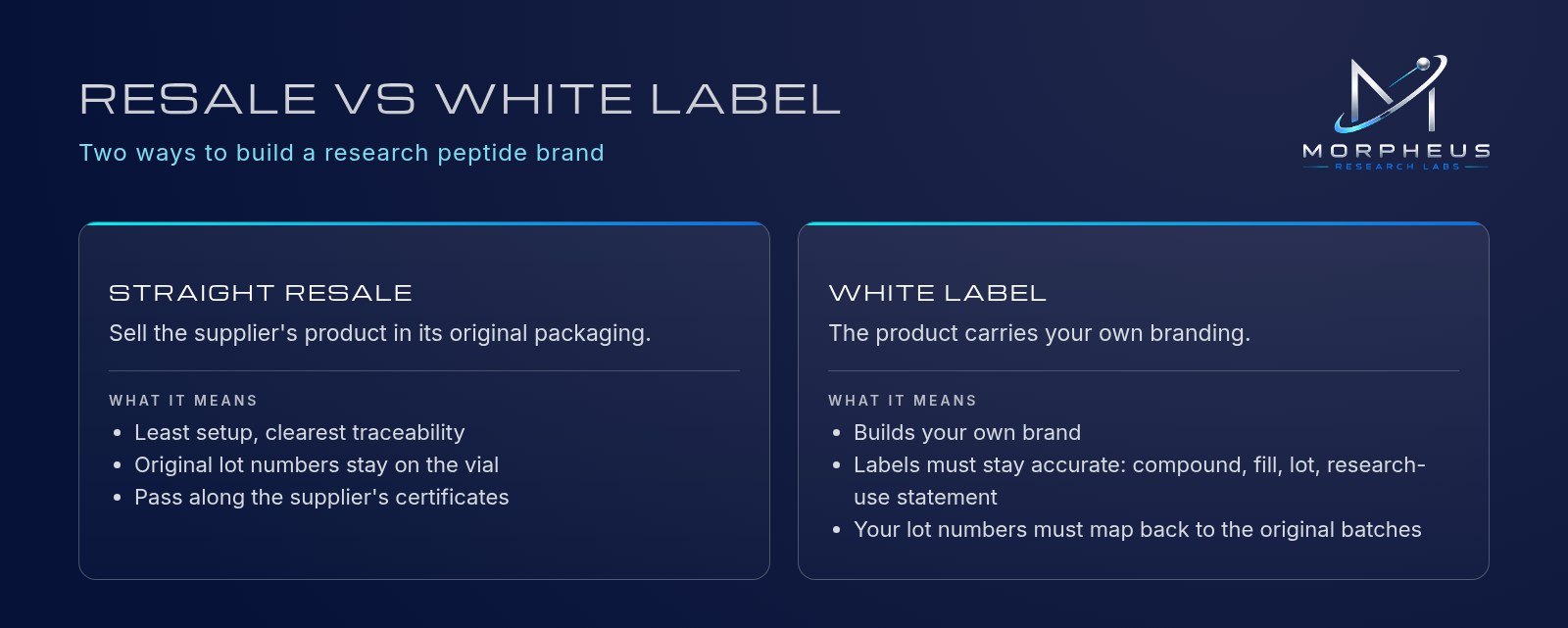
Straight resale means you sell the supplier's product in its original packaging. The supplier's name and lot numbers stay on the vial, and you pass along their certificates. This is the simplest model, with the least setup and the clearest traceability.
White label means the product carries your branding. The supplier may apply your labels, or you may apply them yourself. This builds your own brand, but it adds responsibilities: your labels must still carry accurate compound names, fill sizes, lot numbers and research-use statements, and your documentation must map your lot numbers back to the original batches.
Choosing a supply partner
Your brand is only as good as the material behind it. Before committing, apply the same checks a careful lab would (our 12-point supplier checklist covers them in detail):
- Batch-specific certificates with HPLC purity and mass spectrometry identity.
- Independent third-party testing, where each certificate has a scannable QR code linking to a reputable testing lab's record with matching lot and test numbers.
- Lot numbers on vials that match the certificates.
- Clear storage and shipping practices.
- A dispute process for damaged or questioned material.
Then add reseller-specific questions:
- What are the minimum order quantities, and can compounds be mixed?
- How stable is supply for the compounds you plan to carry?
- Will the supplier provide certificates in a form you can share with your own customers?
- Can they apply custom labels, and what information must remain on the vial?
- How much notice will you get of price changes or discontinued items?
Labelling essentials
Whatever the design, a research peptide label should clearly show:
- Compound name exactly as it appears on the certificate.
- Fill quantity, for example 10 mg.
- Lot or batch number.
- Storage guidance, such as "store refrigerated, protect from light."
- A plain research-use statement, for example "For research use only. Not for human or veterinary use."
Avoid anything on the label or packaging that suggests a human use, a dose or a benefit. Product names, colours and imagery should signal a laboratory product, not a supplement or wellness item.
Managing documentation
Documentation is where white-label brands most often fall down. A customer will ask for the COA for the lot they received, and you need to supply it quickly. If you are not sure what a complete certificate looks like, our guide to reading a peptide COA walks through one section by section. A simple system works:
- Keep a register that maps each of your lot numbers to the supplier's lot and certificate.
- Store certificates in a shared folder named by lot.
- Publish current certificates on your site where possible, each with its scannable QR code so customers can confirm the lot number and test number with the testing lab.
- Retire certificates from your site when a lot sells out, but keep them on file.
If you re-test material yourself, keep those reports with the supplier's certificate. Your own independent confirmation can be a real selling point.
This is what we do at Morpheus Research. Our own independent testing caught a vial labelled 10 mg that measured only 6.68 mg. We pulled that lot, replaced the affected vials for customers, and now independently test material from every supplier. The full story is in our buyer's guide to research peptides in Canada.
Storage and fulfilment
Holding inventory means taking on storage responsibilities. Lyophilized peptides are generally kept cold and dry, away from light. Plan refrigerated or frozen capacity, track stock by lot, and ship oldest lots first. Pack vials so they cannot break or get damp in transit, and use tracked shipping. For Canadian customers, domestic dispatch avoids customs delays that could leave parcels sitting at unknown temperatures.
Marketing within the rules
Research peptides cannot be promoted on the major ad platforms, so resellers rely on search, email, communities and direct outreach to labs. The rule for all of it is the same: stay strictly within research use.
That means:
- No human dosing information, protocols or "stacks."
- No claims that a compound treats, cures, heals or prevents anything.
- No testimonials about personal results or before-and-after images.
- When you mention research, cite the real study and describe the model: cell culture, rodent or clinical trial.
This is not only about compliance. Payment processors, hosting providers and domain registrars all review merchants in this category, and health claims are the most common reason accounts are closed. A brand that keeps its content scientific and research-oriented is a more durable business.
Pricing and margins
Set prices from your full landed cost: product, shipping in, labels and packaging, storage, outbound shipping, payment fees and the cost of keeping certificates current. Factor in some loss from breakage and returns. Competing purely on price is difficult because serious buyers care more about documentation and reliability.
Launch checklist
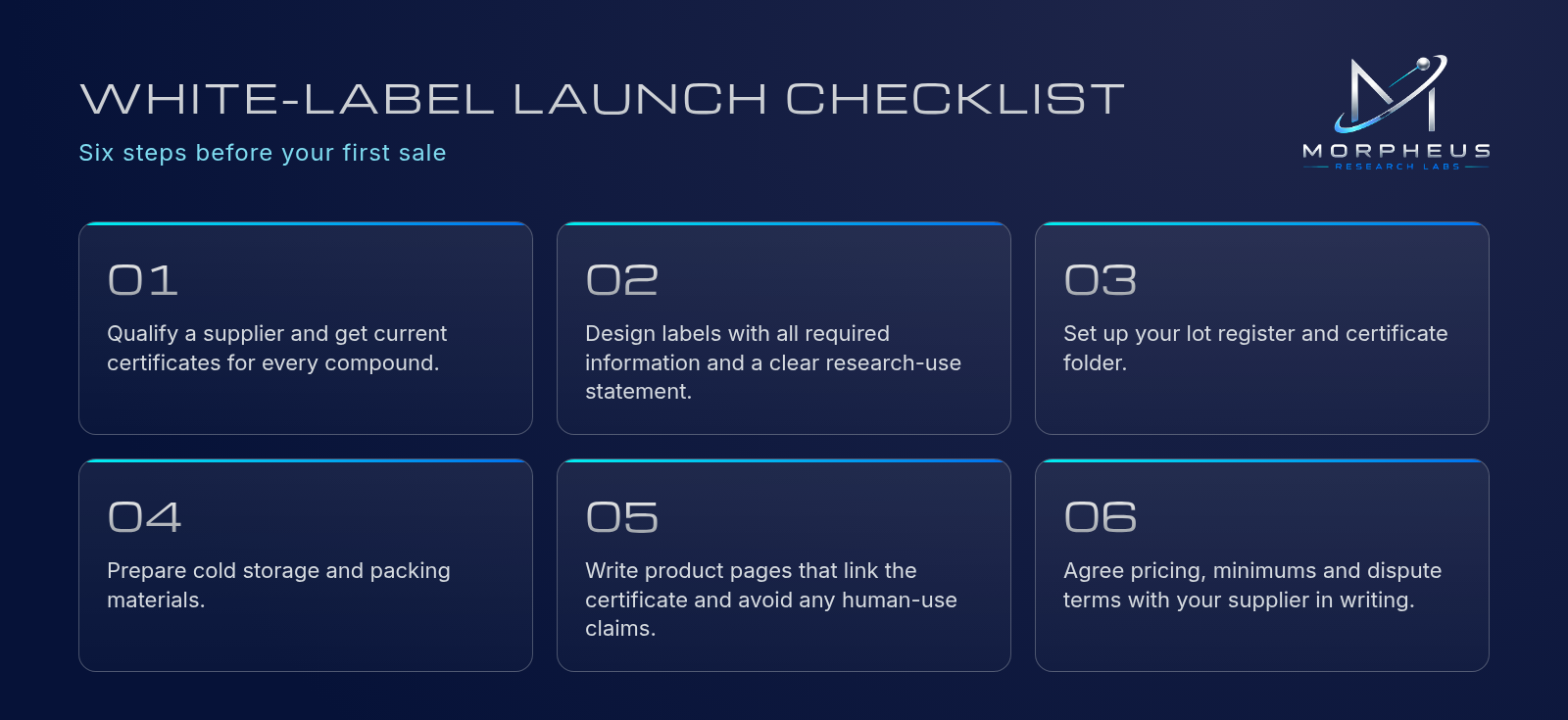
- Qualify a supplier and receive current certificates for every compound you will carry.
- Design labels with all required information and a clear research-use statement.
- Set up your lot register and certificate folder.
- Prepare cold storage and packing materials.
- Write product pages that describe the compound, link the certificate and avoid any human-use claims.
- Agree pricing, minimums and dispute terms with your supplier in writing.
Customer service as a product
For a reseller, customer service is a large part of what customers are paying for. Research buyers return to brands that answer questions quickly and accurately. A few practices make a real difference:
- Certificate requests answered the same day. If your lot register is in order, this takes minutes.
- Clear handling information. Publish general storage and reconstitution guidance for laboratory use on each product page, and keep it consistent with the supplier's guidance.
- Honest stock status. Show when items are out of stock rather than taking orders you cannot fill.
- A clear process for problems. Breakage, missing items and disputed results should each have a documented response.
What customer service should not include is personal-use advice. Staff who answer messages need a simple, consistent response when someone asks about dosing or human use: the products are for laboratory research only, and you cannot advise on personal use. Write that response down and make sure everyone uses it.
Choosing which compounds to carry
It is tempting to list everything a supplier offers. A narrower range is often easier to manage well. Consider:
- Demand. Which compounds do your target customers actually ask for?
- Supply stability. Which compounds does your supplier keep consistently in stock?
- Documentation. Which compounds come with complete, independent certificates for every lot?
- Storage needs. Some products need more careful handling than others.
Start with a focused core range and expand once fulfilment and documentation run smoothly.
Protecting the brand
A white-label brand is an asset that takes time to build and very little time to damage. The fastest ways to lose it are poor-quality material, missing documentation and marketing that crosses into health claims. The first two are managed by choosing a good supplier and keeping records. The third is managed by setting rules for every channel: website, email, social media and community posts. Review any new marketing copy against those rules before it goes live, and remove user-generated content, such as reviews or comments, that describes personal use.
Partnering with Morpheus Research
Morpheus Research supplies Canadian wholesale and white-label partners. We carry the popular research peptides and, thanks to our supply chain, can also source hard-to-find and specialty compounds, so your range is not limited to what is easy to find.
Every lot comes with a COA that carries a scannable QR code, which you can pass on to your own customers, and our COAs are always posted on our website. Browse the current catalogue and our guide to choosing a bulk peptide supplier in Canada, then send your planned compound list and volumes through our contact page to discuss wholesale or white-label terms.
Frequently asked questions
Do I need my own lab to resell research peptides? No, but you need a supplier who tests every batch and provides certificates you can pass on. Many resellers also commission occasional independent tests.
What must stay on a white-label vial? Compound name, fill size, lot number, storage guidance and a research-use statement at a minimum.
Can I publish dosing information for customers? No. Research peptides are not for human use, and dosing content undermines the research-only basis of the business.
How do I handle COA requests? Keep a register linking your lots to supplier lots and certificates, so you can send the right document immediately.
Why do payment processors care about marketing? Health and treatment claims are a common reason processors close accounts in this category. Research-focused content lowers that risk.
Research use only. All products sold by Morpheus Research are intended strictly for laboratory research and are not for human or veterinary consumption. Nothing in this article is medical advice, and no statement here is intended to diagnose, treat, cure or prevent any condition. Study findings are reported as published and should not be read as evidence of effects in people.
For research use only. Not for human consumption.