Peptide COA Explained: How to Read a Certificate of Analysis
Learn to read a research peptide certificate of analysis: lot numbers, HPLC purity, mass spec identity, net content, test dates and signs of a weak COA.
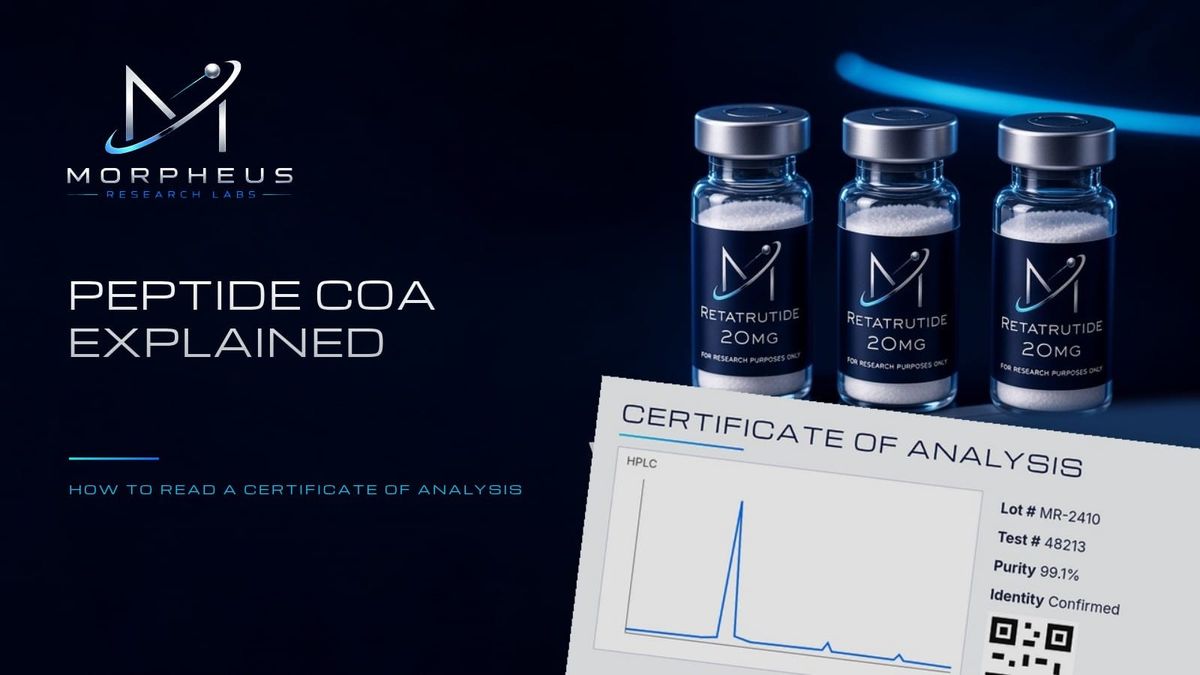
A certificate of analysis, usually shortened to COA, is the single most important document that comes with a research peptide. It is the supplier's evidence that a specific batch contains the right molecule at an acceptable purity. Yet many buyers glance at the purity percentage and move on. That leaves most of the useful information unread, and it makes it easy to miss a certificate that does not really support the product.
This guide goes through a typical peptide COA section by section, explains what each part means, and lists the warning signs that suggest a certificate deserves a closer look.
Why third-party testing matters
There are two broad kinds of certificate. The first is produced by the manufacturer, using its own quality-control lab. The second is produced by an independent analytical laboratory that receives a sample and reports what it finds. Both have value, but they are not equal. An independent lab has no commercial interest in the outcome, so its report is stronger evidence. Many careful suppliers obtain both: the manufacturer's release data and an independent confirmation of the lot they actually stock.
Reputable testing labs now issue each report with a unique test number and a scannable QR code that opens the report on the lab's own verification page. Scanning the code lets a buyer confirm the document is genuine and unaltered, and that the lot number and test number on the lab's record match the certificate and the vial.
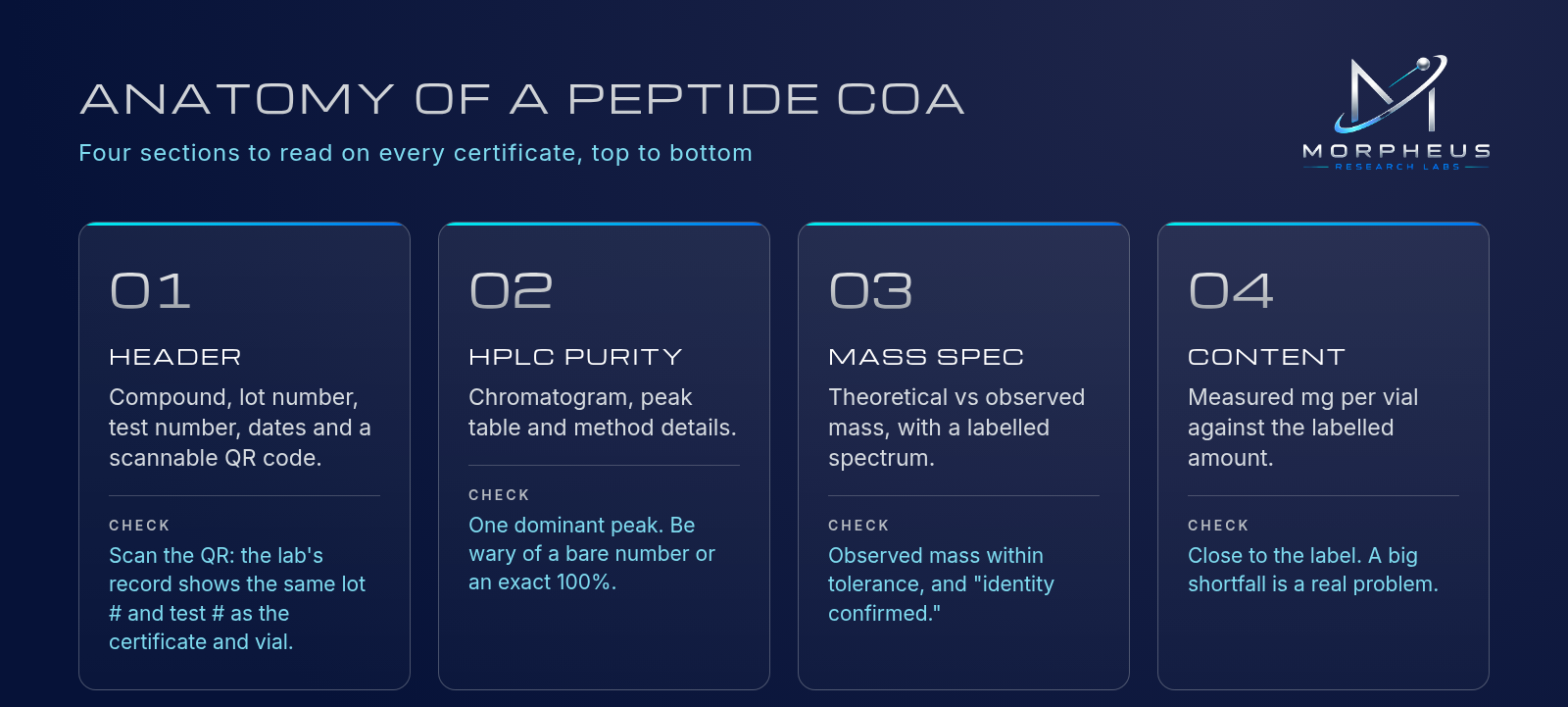
The header: who, what and when
A good COA is tied to one specific lot by numbers that match everywhere they appear: on the certificate, on the vial label and on the lab's own record. The top of a COA should identify:
- Compound name and sequence or formula. For a peptide this may include the amino acid sequence, molecular formula and theoretical molecular weight.
- Lot or batch number. This must match the label on your vial.
- Sample identifier. The lab's internal reference for the sample it tested.
- Test date and report date. These tell you how recent the analysis is.
- A scannable QR code. It should link the report to a reputable testing lab's verification page, where the lot number, test or report number and other details match what is on the certificate and the vial.
- Client name. The supplier who submitted the sample.
If any of these are missing, ask why. A certificate without a lot number cannot be tied to a specific batch, which removes most of its value.
HPLC purity
High-performance liquid chromatography separates the components of a sample as it travels through a packed column. A UV detector records signal over time, producing a chromatogram: a line with peaks at the times each component reaches the detector.
The main peak should be the target peptide. Smaller peaks represent impurities such as truncated sequences, deletion sequences, or by-products of synthesis. Purity is usually calculated as the area of the main peak divided by the total area of all peaks.
When reading this section, look for:
- The chromatogram itself, not just a number.
- A single dominant peak with a reasonably sharp shape.
- Method details: column type, mobile phase, gradient and detection wavelength. These make the result reproducible.
- Integration table: the list of peaks with retention times and areas.
A purity figure reported as exactly 100% should raise eyebrows. Real samples nearly always show some minor peaks, and a careful lab reports them.
Mass spectrometry identity
HPLC tells you a sample is mostly one thing. Mass spectrometry tells you what that thing is. The instrument ionizes the sample and measures the mass-to-charge ratio of the ions. For a peptide, the observed mass is compared with the theoretical mass calculated from its sequence.
A good identity section shows:
- Theoretical mass for the intended peptide.
- Observed mass or the observed ions, often several charge states for larger peptides.
- A spectrum with the relevant peaks labelled.
- A conclusion, such as "conforms" or "identity confirmed."
Without mass data, a highly pure sample could in principle be the wrong peptide. Identity and purity together are what make a certificate convincing.
Net peptide content
A lyophilized peptide is not pure peptide by weight. The powder also contains counter-ions, commonly acetate or trifluoroacetate from purification, plus some residual water. Net peptide content estimates how much of the weighed material is the peptide itself. Some labs also report a quantity per vial, for example measured milligrams against the labelled amount.
This matters for anyone preparing solutions at a specific concentration. Two vials with identical HPLC purity can contain different amounts of peptide.
We have seen this in our own testing. A vial labelled 10 mg of retatrutide measured only 6.68 mg. We pulled that lot, replaced the affected vials for customers, and now independently test material from every supplier before it is sold. The full story is in our buyer's guide to research peptides in Canada.
Additional tests
Depending on the lab and the buyer's needs, a COA may also include:
- Endotoxin testing, relevant for cell culture and in vivo research where bacterial endotoxins could interfere with results.
- Water content, often by Karl Fischer titration.
- Appearance, such as "white lyophilized powder."
- Solubility in a stated solvent.
These are not always included, but they are useful when your work is sensitive to contaminants.
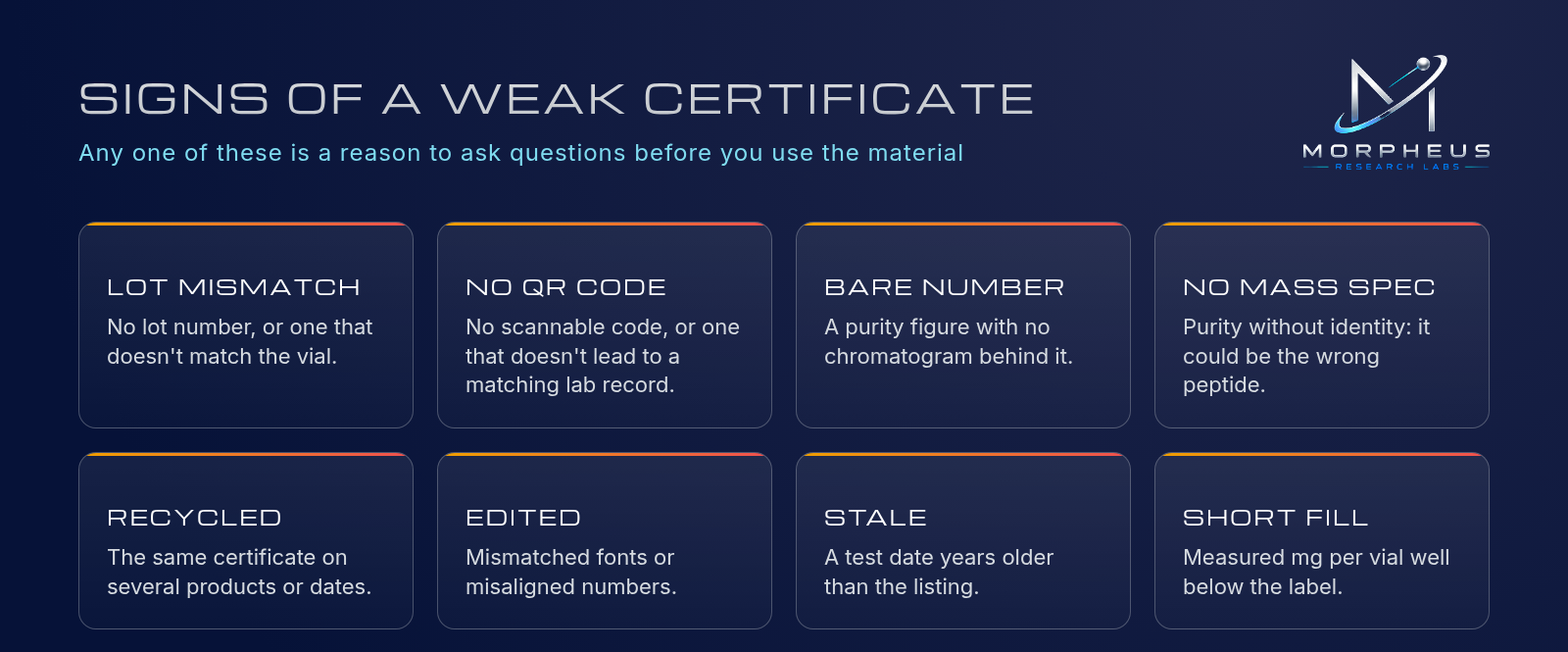
Signs of a weak certificate
- No lot number, or a lot number that does not match the vial.
- No scannable QR code, or a code that does not lead to a reputable testing lab's record with matching lot and test numbers.
- A purity number without a chromatogram.
- No mass spectrometry section.
- The same certificate attached to several products or dates.
- Signs of editing, such as mismatched fonts or misaligned numbers.
- A test date years older than the product listing.
None of these prove fraud on their own, but each one is a reason to ask questions before relying on the material.
How to use COAs in your workflow
For labs, file the certificate with your experimental records so the batch used in each experiment is documented. For resellers, keep certificates organized by lot so you can send the right document to each customer quickly. For everyone, request the certificate before ordering whenever possible, and check the lot number on arrival before the vial goes into storage.
If you run larger studies, consider sending a sample from a new lot to your own chosen lab occasionally. It is a modest cost compared to repeating an experiment.
A walk-through: reading one certificate from top to bottom
Here is how an experienced buyer might read a typical certificate in under five minutes.
Header. The compound name matches the order. The lot number on the certificate is compared against the vial label and matches. The test date is within the last few months. The report carries a scannable QR code, and scanning it opens the testing lab's record with the same lot number and test number.
HPLC section. The chromatogram shows one tall main peak and a few small ones. The integration table lists each peak's retention time and area, and the main peak accounts for the stated purity. Method details give the column, gradient and detection wavelength.
Mass spectrometry section. The theoretical mass for the peptide is listed. The observed mass, or a series of charge-state peaks that resolve to it, sits within a small tolerance of the theoretical value. The conclusion reads "identity confirmed."
Content section. The measured amount per vial is reported against the labelled amount. It is close to the label, slightly above or below.
Verification. Scanning the QR code opens the report on the testing lab's own verification page, and the lot number, test number and results there match the certificate.
If any step fails, for example the lot number does not match, or the mass section is missing, stop and ask the supplier before using the material.
Common questions from new buyers
"The purity on my certificate is lower than the website says." Websites often state a minimum specification, such as "98% or higher," while certificates report the measured result for a lot. A measured result above the specification is fine. A result below it is a reason to ask questions.
"Two labs gave different purity numbers for the same lot." This is normal within a small range. HPLC methods differ in column, gradient and integration settings, which can shift results slightly. Large differences, or a different identity, are not normal.
"The content is higher than the label." Suppliers often overfill slightly so that the vial is never short. Very large overfills, like large underfills, are worth asking about because they affect concentration calculations.
"The certificate is for a different fill size." Some suppliers test a single lot of bulk material and then fill it into several vial sizes. That can be legitimate, but the certificate should make that link clear, and the lot number should still match.
Getting documentation from Morpheus Research
Our COAs for every lot are always posted on our website, and each one carries a scannable QR code so you can confirm the lot number and test number with the testing lab yourself. You can browse them alongside our catalogue.
We carry the popular research peptides and, thanks to our supply chain, can also source hard-to-find and specialty compounds. Wholesale buyers receive certificates for every lot they order. To ask about a compound or wholesale pricing, reach us through our contact page. For more on buying in volume, see our guide to choosing a bulk peptide supplier in Canada, and our 12-point checklist for vetting a peptide supplier.
Frequently asked questions
What does COA stand for? Certificate of analysis: a lab report on a specific batch of material.
Is HPLC purity enough? No. HPLC shows how uniform a sample is; mass spectrometry confirms what it is. You want both.
What is a good purity for a research peptide? Many research suppliers specify 98% or higher. Always look at the chromatogram behind the number.
Why is net content lower than the vial label? These are two different measurements. Net peptide content is the percentage of the powder that is peptide; it is lower than 100% because the powder also holds counter-ions and water. The measured milligrams per vial is a separate figure, and it should still be close to the labelled amount. A large shortfall per vial is a real problem, and net content does not explain it.
How can I verify a COA is real? Scan the QR code on the certificate. It should open the report on a reputable testing lab's verification page, and the lot number and test number there should match the certificate and your vial.
Research use only. All products sold by Morpheus Research are intended strictly for laboratory research and are not for human or veterinary consumption. Nothing in this article is medical advice, and no statement here is intended to diagnose, treat, cure or prevent any condition. Study findings are reported as published and should not be read as evidence of effects in people.
For research use only. Not for human consumption.