Research Peptides in Canada: A Practical Buyer's Guide for Labs
How Canadian labs can source research peptides: purity, net content and endotoxin testing, COAs, and what to ask a supplier. Includes our own test results.
Interest in synthetic peptides has grown quickly across Canadian universities, contract research groups and independent laboratories. Peptides are short chains of amino acids, usually between two and fifty residues long, and they sit in a useful middle ground between small molecules and full proteins. They can be synthesized to a defined sequence, characterized with standard analytical chemistry, and studied in cell culture or animal models with a level of control that larger biologics rarely allow.
That growth has also produced a crowded supplier market. A search for "research peptides Canada" returns dozens of storefronts, and from the outside many of them look the same: clean product photos, a purity percentage, and a "for research use only" line in the footer. This guide explains what actually separates a dependable source from a risky one, and what a Canadian lab should check before placing a first order.
What "research use only" means
Every legitimate supplier in this category sells compounds for laboratory research. That means in vitro work, analytical method development, and properly approved preclinical studies. It does not mean human consumption, and it does not mean veterinary use outside an approved protocol. Research-use-only (RUO) products are not drugs, they have not been reviewed by Health Canada for any clinical purpose, and they carry no dosing instructions for people.
A supplier that blurs this line, by describing what a peptide "does for you," publishing human dosing charts or posting before-and-after photos, is a supplier worth avoiding. Beyond the legal problem, that marketing style usually signals a business that is not thinking carefully about quality either.
The four things that matter most
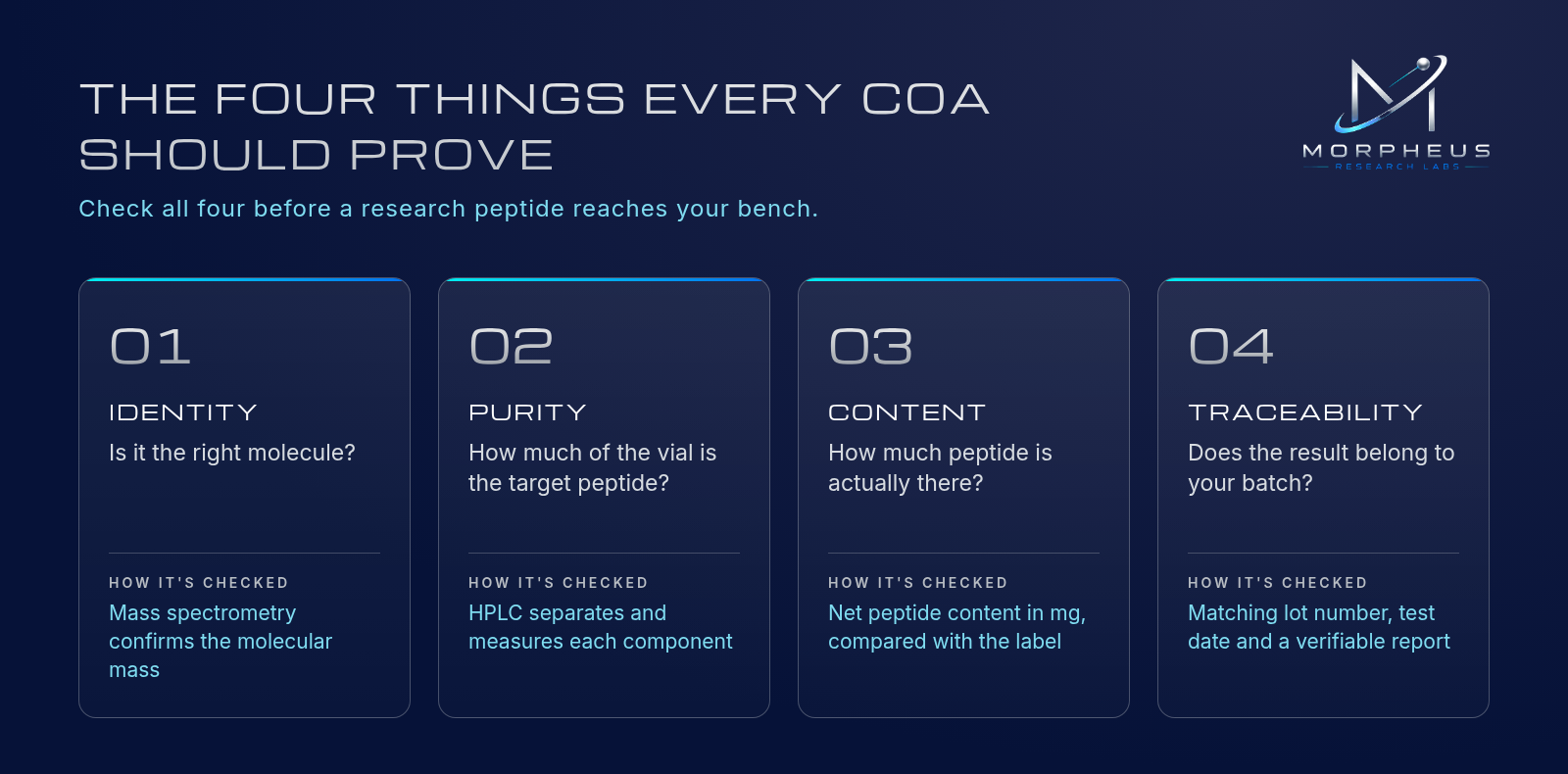
1. Identity: is it the right molecule?
The first question about any vial is whether it contains the sequence on the label. Identity is normally confirmed with mass spectrometry (MS), which measures the molecular mass of the compound and compares it against the theoretical mass of the intended sequence. A matching mass is strong evidence that the correct peptide was synthesized. A certificate of analysis (COA) that shows only an HPLC purity figure, with no mass data, tells you the sample is fairly uniform, but not what it is.
2. Purity: how much of the vial is the target peptide?
Purity is typically measured with high-performance liquid chromatography (HPLC). The sample is pushed through a column, the components separate, and a detector records peaks over time. The area of the main peak relative to the total gives a purity percentage. Most reputable research suppliers specify a minimum purity, often 98% or 99%, and publish the chromatogram so a buyer can see the peak shape rather than taking a number on trust.
3. Content: how much peptide is actually there?
Purity and quantity are different measurements. A vial labelled 10 mg might contain a very pure peptide but less material than stated, or more. Some independent labs now report net peptide content alongside purity. When a COA lists both, a buyer can see whether the fill matches the label.
4. Traceability: can the result be tied to your batch?
A COA is only useful if it belongs to the lot you received. Look for a batch or lot number on the vial that matches the certificate, a test date, and a way to verify the report with the testing lab. Several Canadian suppliers now link each certificate to a verification page on the testing lab's own site, which is a good standard to expect.
What our own testing found: a "10 mg" vial with 6.68 mg inside
This is not a hypothetical. In October 2026 we sent samples to an independent Canadian analytical laboratory for HPLC-MS/MS testing, which uses liquid chromatography paired with tandem mass spectrometry to confirm identity, measure purity and quantify how many milligrams of peptide are actually in the vial.
One of those samples was a retatrutide vial from a wholesale supplier, already packed under our own label and marked 10 mg. On paper it looked fine. Here is what the lab measured:
| Test | Specification | Result |
|---|---|---|
| Net peptide content | 10.00 mg | 6.68 mg |
| Peptide fill accuracy | ≥ 90% | 66.8% |
| Chromatographic purity | ≥ 98% | 98.7% |
The lab's QA comment read: "Significantly lower recovery compared to label claim."
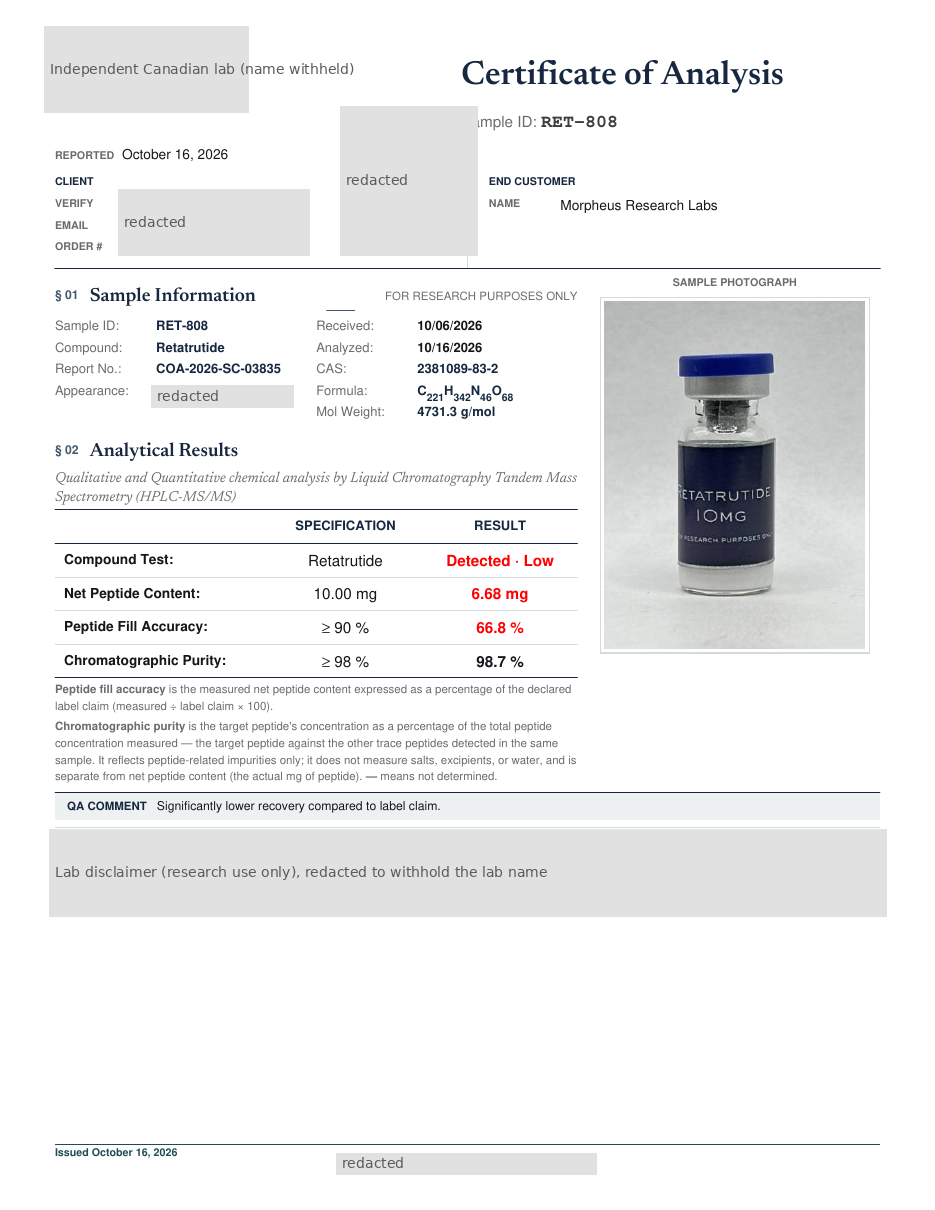
Independent COA for the retatrutide vial labelled 10 mg. Net peptide content came in at 6.68 mg. The lab's name and verification details are withheld.
Look closely at that purity figure. At 98.7%, the vial passes the purity specification. A COA that showed only HPLC purity would have made this vial look perfectly acceptable. It was only the net content measurement that showed roughly a third of the labelled material was missing. Purity tells you what share of the peptide in the vial is the right peptide. It does not tell you how much peptide is there.
This is exactly why we test what we receive rather than trusting a wholesaler's paperwork. Most buyers in this space never send a vial for independent testing. They rely on the supplier's paperwork, which often reports purity alone. Those buyers would have no way of knowing their "10 mg" vial held under 7 mg, and every calculation built on that label would be off by about a third.
Some of these vials had already reached researchers before the results came back. As soon as we saw the shortfall, we contacted every researcher who had received one from that lot and replaced their vials free of charge. We would rather tell you about a problem we caught than pretend testing never finds one. It does, and that is the whole point of doing it.
We have since sent a new round of samples, covering every supplier we use, for independent testing, and we will publish those certificates as they come back.
For comparison, two other compounds tested in the same period met or exceeded their label claims:
| Compound | Label claim | Net peptide content | Fill accuracy | Purity |
|---|---|---|---|---|
| Tirzepatide | 20.00 mg | 23.87 mg | 119.3% | 99.6% |
| GHK-Cu | 100.00 mg | 115.30 mg | 115.3% | 99.7% |
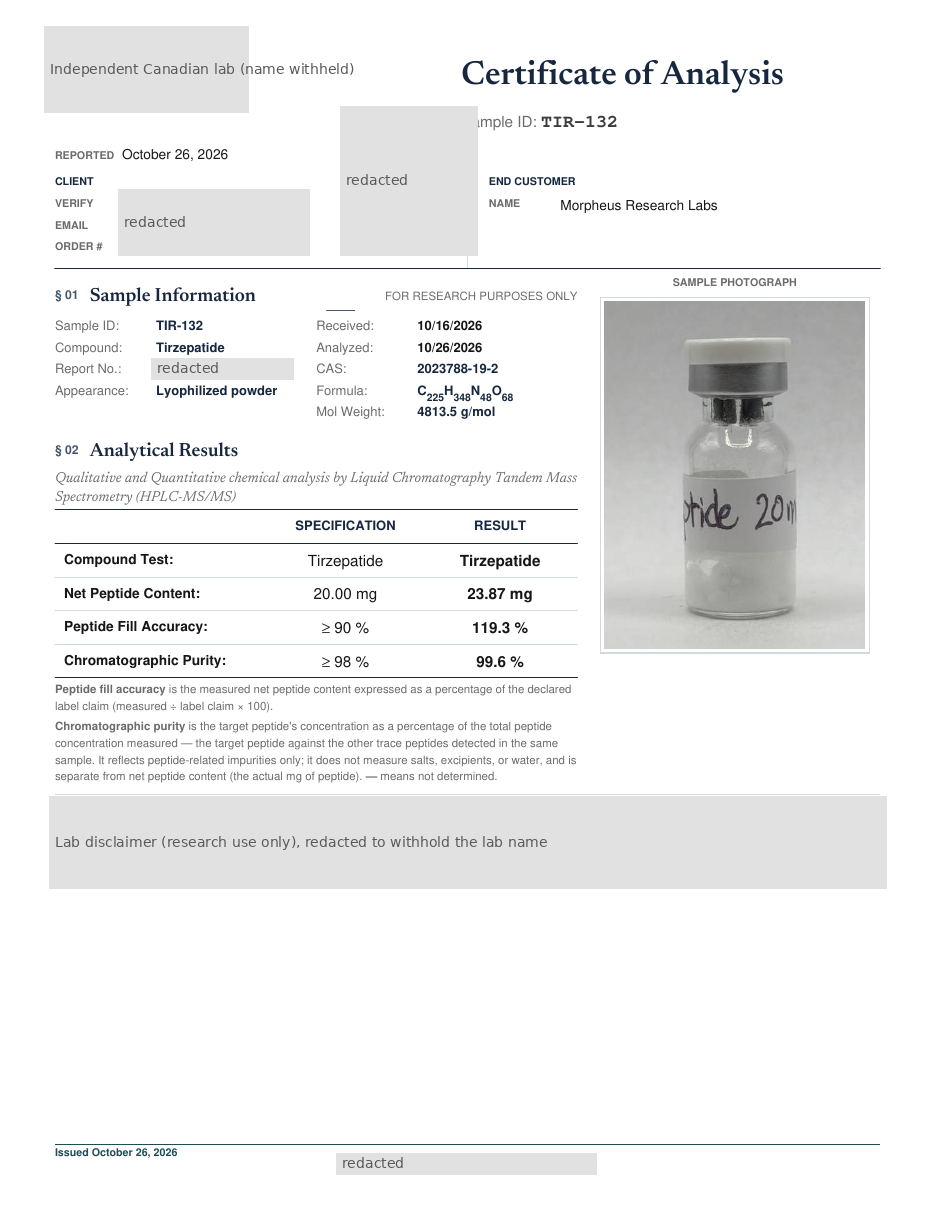
Tirzepatide, labelled 20 mg: 23.87 mg measured, 119.3% fill accuracy.
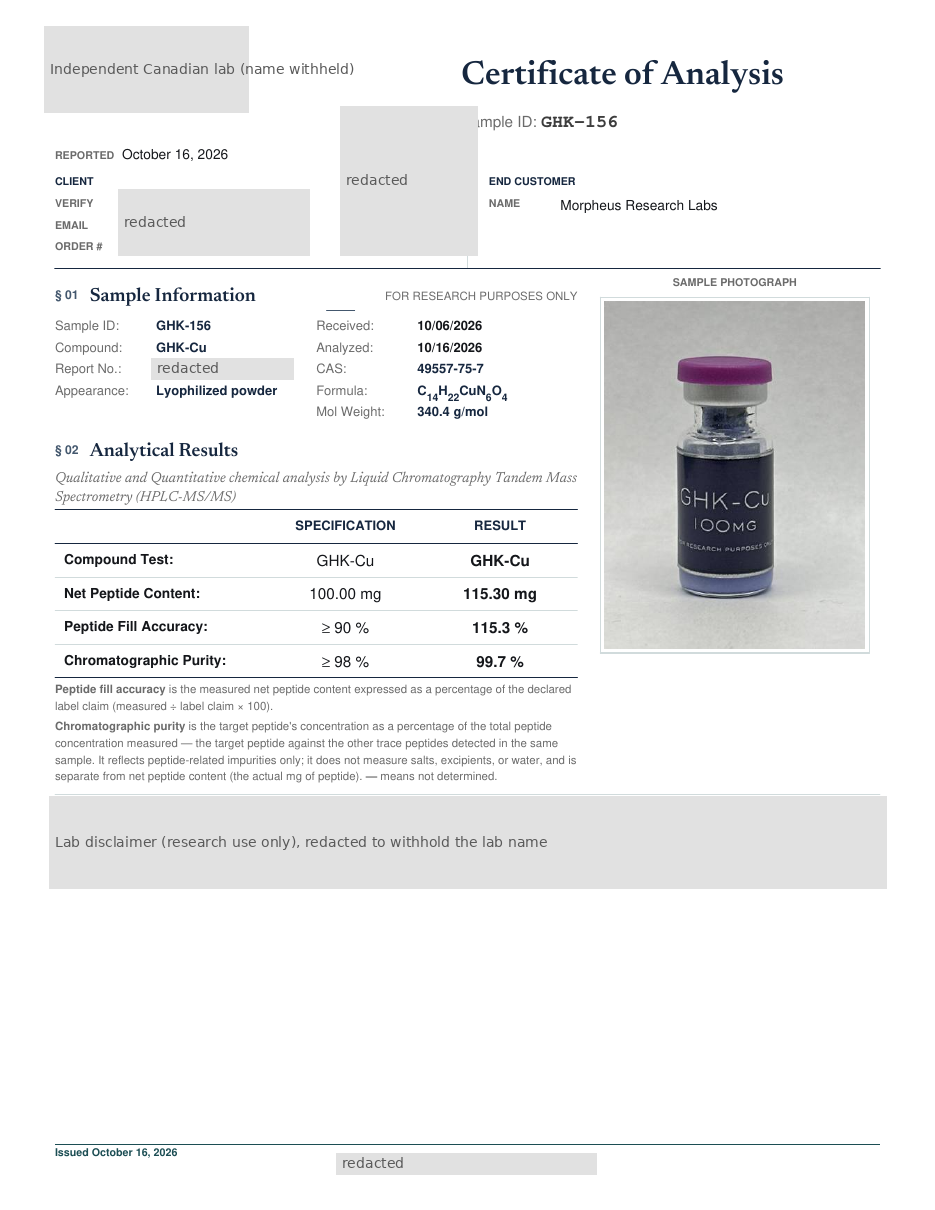
GHK-Cu, labelled 100 mg: 115.30 mg measured, 115.3% fill accuracy.
Overfill is common and generally harmless for planning purposes, since manufacturers often add a margin. Underfill on the scale of the retatrutide result is the problem, and it is invisible without quantitative testing.
Endotoxin testing: the test many suppliers skip
Identity, purity and content describe the peptide itself. Endotoxin testing looks for something else: bacterial contamination left behind during synthesis, handling or packaging.
Endotoxins are lipopolysaccharides (LPS), fragments of the outer membrane of gram-negative bacteria. They are not destroyed by freeze-drying, they are not removed by filtering out live bacteria, and they do not show up on an HPLC purity result. In cell culture and animal research, even small amounts of endotoxin can trigger strong inflammatory responses, which can confound results and make an experiment impossible to interpret.
The standard method is the Limulus Amebocyte Lysate (LAL) test, described in USP <85>. A kinetic chromogenic LAL assay gives a quantitative result in endotoxin units (EU).
We had the same retatrutide lot tested for endotoxin, using a kinetic chromogenic LAL/TAL test (USP <85>) on the whole vial reconstituted. It measured 0.394 EU/mL, within the kit's 1 EU/mL limit.
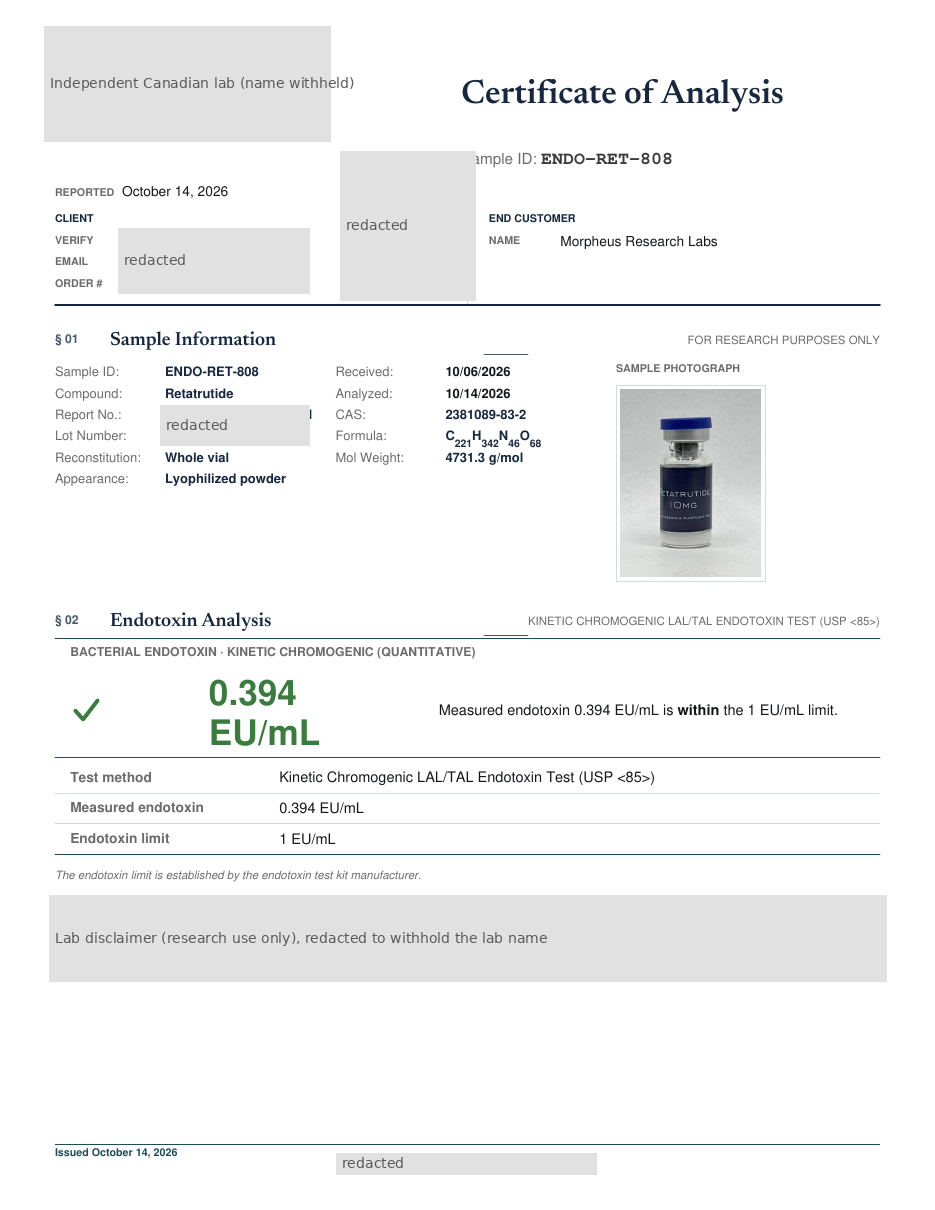
Endotoxin result for the same retatrutide lot: 0.394 EU/mL, within the 1 EU/mL limit. The lab's name is withheld.
So the material was clean from a contamination standpoint. Its problem was quantity, not contamination, and only running both tests made that clear.
Many peptide suppliers in North America do not run endotoxin testing at all, and their COAs stop at HPLC purity and sometimes mass spectrometry. If endotoxin matters for your work, and for most biological research it does, ask for an endotoxin result specifically. Do not assume a clean purity number covers it.
What this means for your next order
- Ask for net peptide content, not just purity. Fill accuracy (measured ÷ label claim) should be at or above about 90%.
- Ask for endotoxin results (LAL, reported in EU), especially for any biological work.
- Confirm the COA's sample or lot number matches the vial you received.
- When the stakes are high, send a vial for independent testing yourself. It is the only way to know for certain what you are working with.
Canadian considerations
Ordering domestically has practical advantages. Shipments that stay inside Canada avoid customs holds, which matters for lyophilized material that should not sit in a warehouse at unknown temperatures for a week. Domestic suppliers can usually ship tracked parcels with next-day or two-day delivery to major centres such as Vancouver, Calgary, Toronto and Montreal, and pricing is in Canadian dollars, so there are no surprise conversion or brokerage fees.
It is still worth asking where material is synthesized. Most peptides sold in North America are manufactured by contract synthesis facilities and then tested, packaged and distributed locally. That is normal. What matters is that the distributor tests incoming batches independently rather than relying only on the manufacturer's paperwork.
Questions to ask before your first order
- Do you publish a COA for every batch, and does it include both HPLC and mass spectrometry?
- Does the COA report net peptide content (mg) and fill accuracy, not just purity?
- Do you test for bacterial endotoxin (LAL, USP <85>), and can I see the result?
- Is the testing done by an independent third-party lab, and can the report be verified?
- Does the lot number on the vial match the certificate?
- How is material stored before dispatch, and how is it packed for shipping?
- What is your policy if a vial arrives damaged or a result is disputed?
- Do you offer volume pricing for labs that order regularly?
A supplier that answers these questions clearly, in writing, is showing you how they run their business.
Handling once material arrives
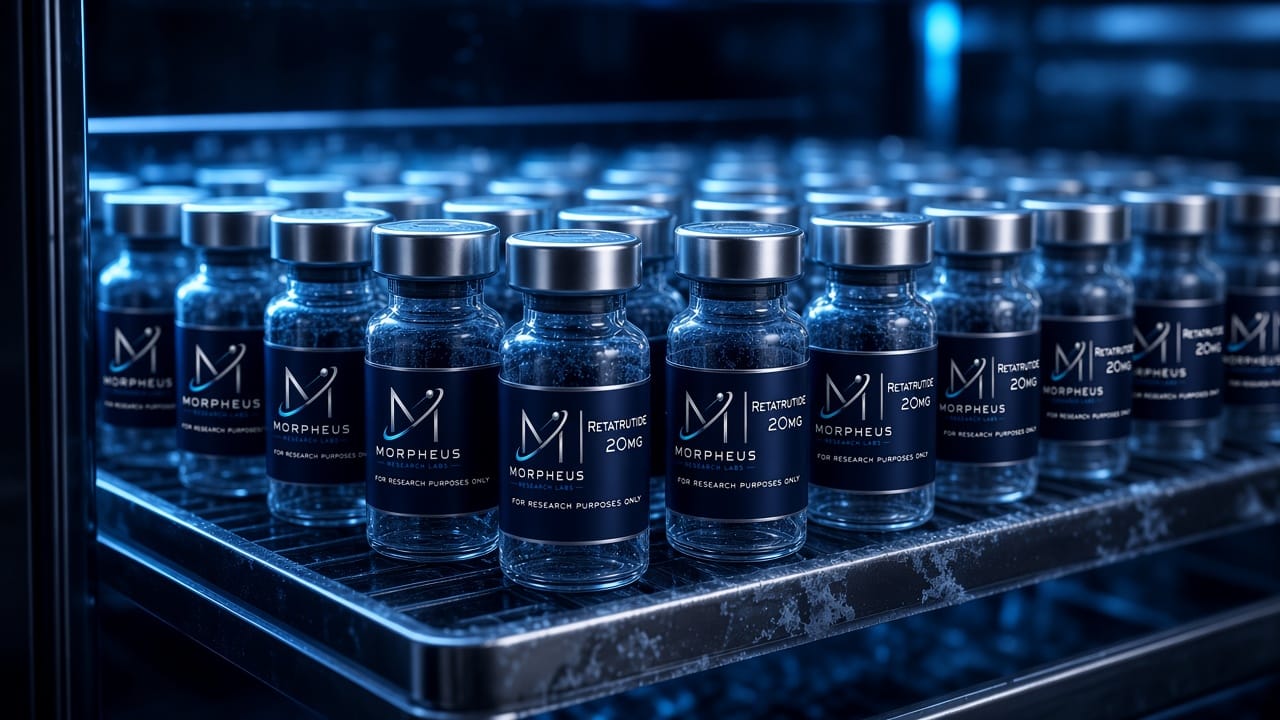
Lyophilized (freeze-dried) peptides are generally stable for transport, but they still benefit from careful handling on arrival. Most labs store unopened vials cold, away from light and moisture, and allow a vial to come to room temperature before opening it so condensation does not form inside. Reconstitution should follow the lab's own standard operating procedures, using an appropriate sterile diluent such as bacteriostatic water, and reconstituted material is usually kept refrigerated and used within a defined window. Our separate guides on storage and reconstitution cover these steps in more detail.
Reading marketing claims critically
Because the category cannot advertise on the major ad platforms, a lot of promotion happens through blogs, forums and social media. Some of that content is careful and well referenced. Much of it is not. A good habit is to trace any claim back to the original paper. If a supplier says a compound "was shown" to do something, the article should name the study, the model used (cell line, rodent, or human trial), and the outcome measured. Preclinical findings in rodents are interesting, but they are not evidence of an effect in people, and responsible writing says so.
Where Morpheus Research fits
Morpheus Research supplies lyophilized research peptides to Canadian buyers, with products listed by compound and fill size. You can browse the current catalogue in our shop. If you are a lab, clinic research group or reseller and want to discuss regular orders, use our contact page to request wholesale pricing.
We test material from every supplier we use, and we are building independent COA coverage for every product we list. Certificates are published as results come in.
Province-by-province practicalities
Canada is a large market, and a few practical details change depending on where a lab is located.
Delivery times. Labs in the Lower Mainland, the Calgary-Edmonton corridor, the Greater Toronto Area and Montreal usually receive domestic tracked parcels quickly. Labs in the North, Atlantic Canada or rural areas should expect longer transit, which makes packaging and the time a parcel spends at room temperature more important. If you are outside a major centre, ask the supplier which carrier they use and whether they can avoid shipping before a weekend.
Seasonal temperatures. Winter shipments to the Prairies can sit in sub-zero vehicles and depots; summer shipments in southern Ontario and the Okanagan can sit in hot trucks. Lyophilized peptides tolerate short excursions better than solutions, but there is no reason to test that. Plan orders so a parcel arrives on a weekday when someone can move it straight into cold storage.
Sales tax on invoices. Research purchases are taxable. The rate depends on the province of delivery: HST in Ontario and the Atlantic provinces, GST alone in some provinces, and GST plus a provincial tax elsewhere. Check that an invoice shows the right tax for your delivery address, because institutional purchasing departments will ask.
Institutional purchasing. University and hospital-affiliated labs often need a vendor set up in a procurement system before an order can be paid. Ask the supplier early whether they can provide a formal quote, an invoice with a business number, and payment by institutional methods. Sorting this out before you need the material avoids weeks of delay.
French-language documentation. Labs in Quebec may need product information or invoices in French for internal records. It is worth asking whether this is available.
Building a short list
A sensible way to start is to shortlist two or three suppliers, request current certificates for the compounds you need from each, and compare them side by side: lab named, lot numbers present, HPLC chromatogram shown, mass spectrometry shown, and test date. That comparison takes less than an hour and usually makes the choice obvious. Place a small first order with your preferred supplier, check that lot numbers match on arrival, and keep the second supplier on file as a backup for the compounds your work depends on most.
Frequently asked questions
Are research peptides legal to buy in Canada? Peptides sold strictly for laboratory research are widely available from Canadian suppliers. They are not approved drugs and must not be sold or used for human consumption. Buyers are responsible for using them within their own institution's rules and any applicable regulations.
What does net peptide content mean? It is the actual weight of peptide in the vial, measured by quantitative analysis. A vial can be high purity and still underfilled, so net content and purity should both appear on a COA.
Do peptide suppliers test for endotoxin? Many do not. Endotoxin testing (LAL, USP <85>) is a separate test from HPLC purity, so ask for it specifically.
What purity should I expect? Many research suppliers specify 98% or higher by HPLC. More important than the headline number is whether you can see the chromatogram and mass spectrometry data for your specific batch.
What is a COA? A certificate of analysis is a lab report for a specific batch. It should name the compound, the lot number, the test date, the methods used and the results.
How long does domestic shipping take? It depends on the supplier and destination, but domestic tracked shipping usually avoids the delays of cross-border customs.
Can I get a COA before I order? Ask. Suppliers who test every batch can usually share the current certificate before purchase.
Research use only. All products sold by Morpheus Research are intended strictly for laboratory research and are not for human or veterinary consumption. Nothing in this article is medical advice, and no statement here is intended to diagnose, treat, cure or prevent any condition. Study findings are reported as published and should not be read as evidence of effects in people.
For research use only. Not for human consumption.