BPC-157 and TB-500 Blends: What the Research Literature Reports
BPC-157 and TB-500 (thymosin beta-4) research: origins, published preclinical findings, blend characterization and lab handling.
BPC-157 and TB-500 are often discussed together, and combined vials are among the most requested research peptide formats in Canada. The pairing makes sense from a research-design point of view: both compounds have been studied in relation to tissue-repair signalling in preclinical models, but they come from entirely different biological origins and are thought to act through different pathways. This article explains where each compound comes from, what the published literature reports, and what researchers should check when working with a blend.
Two different molecules
BPC-157
BPC-157 is a synthetic fifteen-residue peptide derived from a sequence in a gastric protein. Its research literature is mostly preclinical, much of it from one research group in Zagreb, and covers rodent models of gastrointestinal, tendon, muscle and vascular injury. Our separate BPC-157 article covers that literature in more depth.
TB-500 and thymosin beta-4
TB-500 is the name commonly used in the research market for a synthetic peptide related to thymosin beta-4 (Tβ4). Thymosin beta-4 is a naturally occurring 43-amino-acid protein found in most cells, where one of its best-known roles is binding G-actin, the monomeric form of actin, and regulating actin polymerization. Because actin dynamics are central to cell movement, Tβ4 has been studied in relation to cell migration, wound repair and angiogenesis.
Commercial "TB-500" products vary. Some are described as the full Tβ4 sequence, others as a shorter fragment that includes the actin-binding region. This is a good example of why buyers should check the stated sequence and the mass spectrometry result on the certificate, since the expected mass depends on exactly which sequence is supplied.
What the thymosin beta-4 literature reports
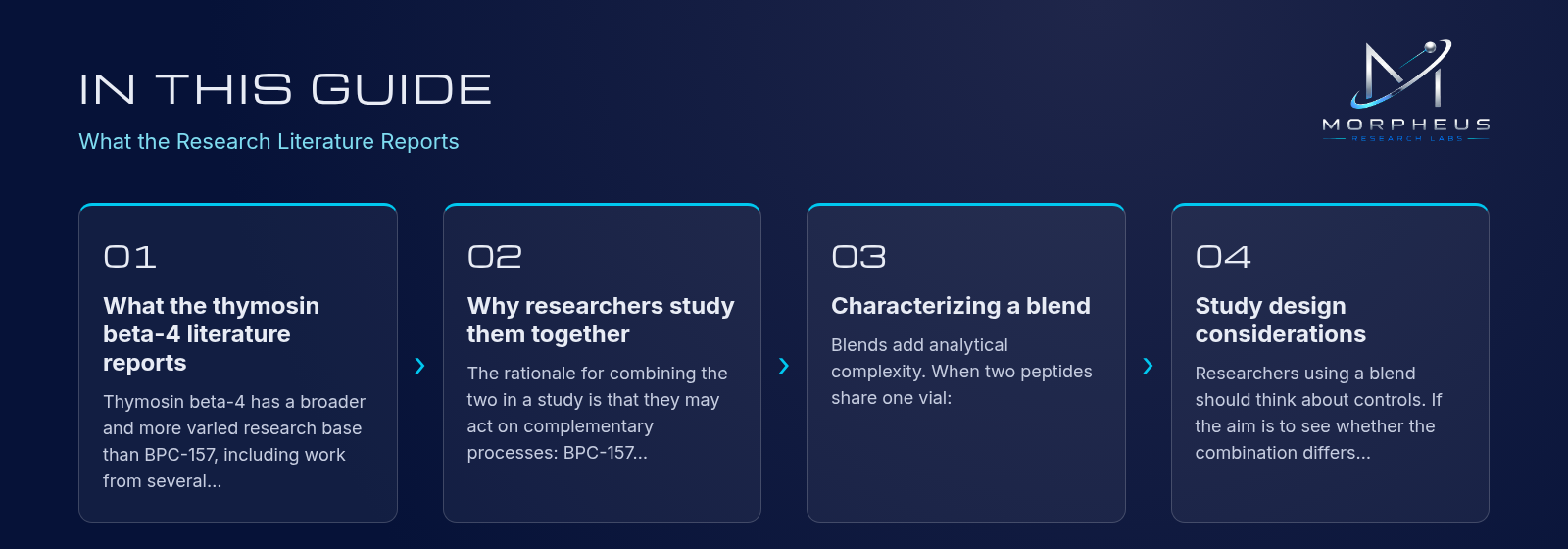
Thymosin beta-4 has a broader and more varied research base than BPC-157, including work from several independent groups. A 2012 review by Goldstein and colleagues in Expert Opinion on Biological Therapy, "Thymosin β4: a multi-functional regenerative peptide," summarized research on Tβ4 in models of dermal, corneal and cardiac injury, and discussed proposed mechanisms including actin sequestration, cell migration and anti-inflammatory signalling. The review also described early clinical investigations of Tβ4 formulations in specific settings, such as topical and ophthalmic research. Those clinical programmes studied defined pharmaceutical formulations, not research-market peptides, and their results should not be transferred to products sold for laboratory use.
Why researchers study them together
The rationale for combining the two in a study is that they may act on complementary processes: BPC-157 research has emphasized vascular and growth-factor signalling, while Tβ4 research has emphasized actin dynamics and cell migration. That is a hypothesis. Published controlled studies directly comparing the combination with each compound alone are scarce, so a blend is best treated as a research material for asking that question, not as a format with an established advantage.
Characterizing a blend
Blends add analytical complexity. When two peptides share one vial:
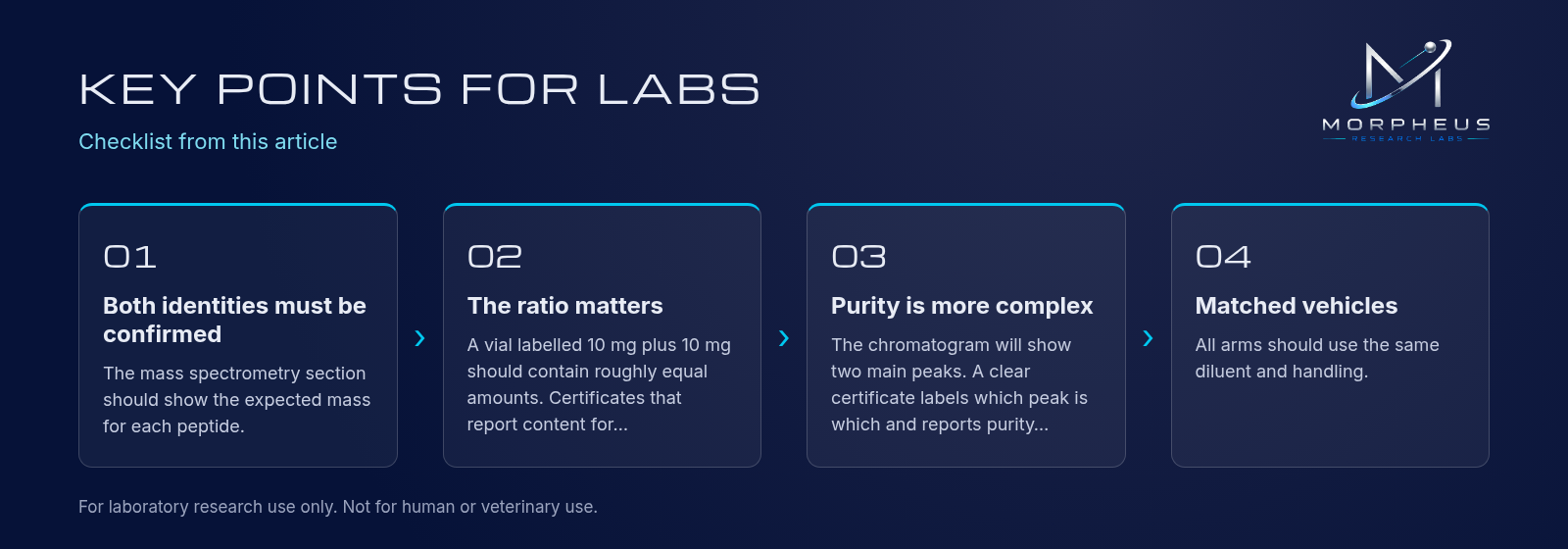
- Both identities must be confirmed. The mass spectrometry section should show the expected mass for each peptide.
- The ratio matters. A vial labelled 10 mg plus 10 mg should contain roughly equal amounts. Certificates that report content for each component are much more useful than a single total figure.
- Purity is more complex. The chromatogram will show two main peaks. A clear certificate labels which peak is which and reports purity for each.
Morpheus Research lists two blend formats: BPC-157/TB-500 20mg and BPC 10mg / TB-500 10mg. Ask us for the batch certificate for the lot you are ordering.
Study design considerations
Researchers using a blend should think about controls. If the aim is to see whether the combination differs from each component, single-compound arms are needed. Because blends fix the ratio, researchers who want to vary it will need separate vials of each compound. Document the lot used in each experiment so results can be traced back to a specific certificate.
Handling and storage
Both peptides are supplied lyophilized. Typical laboratory practice is to store unopened vials cold, dry and protected from light, to let a vial reach room temperature before opening, and to reconstitute with a sterile diluent such as bacteriostatic water following the lab's own procedures. Reconstituted solutions are generally kept refrigerated and used within a set period, and repeated freeze-thaw cycles are avoided. Our storage and reconstitution guides cover this in more detail.
Responsible language
Because blends are popular in fitness and recovery communities, a lot of online content about them goes far beyond the evidence. Accurate wording ties each statement to a study: "a review of thymosin beta-4 research described findings in dermal and corneal injury models." Wording such as "speeds healing" or "repairs injuries" overstates the evidence and has no place in research-use material.
Ordering
Browse blends and single compounds in the shop, or request volume pricing through the contact page.
Designing a comparison study with a blend
If the research question is whether BPC-157 and TB-500 together differ from each alone, the study design matters more than the material. A typical design includes four arms:
- Vehicle control.
- BPC-157 alone.
- TB-500 alone.
- The combination.
To make the combination arm comparable, the amounts of each peptide in arm 4 should match those in arms 2 and 3. A pre-mixed blend can supply arm 4, but only if its certificate reports the content of each component. Otherwise, preparing the combination from separate single-compound vials gives more control.
Other design points:
- Matched vehicles. All arms should use the same diluent and handling.
- Randomization and blinding. Allocate samples or animals randomly and code them so outcome assessment is blind.
- Pre-specified outcomes. Decide in advance which measures are primary, to avoid selecting favourable results afterward.
- Power. Small studies with many outcomes produce unreliable results. A simple sample-size calculation helps.
Analytical challenges specific to blends
Blends make analysis harder in a few specific ways.
Peak overlap. On HPLC, the two peptides need to separate cleanly for each purity figure to be meaningful. If they co-elute, or if an impurity from one overlaps with the other, the reported purities are less reliable.
Quantitation. Reporting content for each component requires calibration against reference standards for both peptides. Not every lab offers this, which is why many blend certificates report only total content.
Stability differences. The two peptides may degrade at different rates in solution, so the ratio in a reconstituted blend can drift over time. Preparing fresh solutions and keeping storage times short limits this.
Choosing between the two blend formats
Morpheus Research lists a 20 mg blend and a 10 mg plus 10 mg format. When choosing, consider the total quantity needed for the study, how many separate preparations you will make, and whether you need content data for each component. Ask for the lot certificate for either format before ordering so you can check how each component was characterized.
Frequently asked questions
Are BPC-157 and TB-500 the same thing? No. BPC-157 is derived from a gastric protein sequence; TB-500 is related to thymosin beta-4, an actin-binding protein.
Is there clinical evidence for the blend? Controlled studies of the combination are scarce. Most research on each compound is preclinical.
What should a blend COA show? Mass spectrometry identity for both peptides, purity for each peak, and ideally content for each component.
Why do TB-500 products vary? Some are described as the full thymosin beta-4 sequence and others as fragments. Check the stated sequence and expected mass.
How should blends be stored? Like most lyophilized peptides: cold, dry and away from light before reconstitution.
Related reading
- Peptide COA Explained: How to Read a Certificate of Analysis
- How to Store Research Peptides: Lyophilized and Reconstituted Handling
- Peptide Reconstitution with Bacteriostatic Water: A Lab Handling Guide
- BPC-157 Wholesale Canada: Research Background and Sourcing Notes
- Research Peptides in Canada: A Practical Buyer's Guide for Labs
References
- Goldstein AL, Hannappel E, Sosne G, Kleinman HK. Thymosin β4: a multi-functional regenerative peptide. Basic properties and clinical applications. Expert Opin Biol Ther. 2012;12(1):37-51. PMID: 22074294.
- Chang CH, et al. The promoting effect of pentadecapeptide BPC 157 on tendon healing involves tendon outgrowth, cell survival, and cell migration. J Appl Physiol. 2011;110(3):774-780. PMID: 21030672.
Research use only. All products sold by Morpheus Research are intended strictly for laboratory research and are not for human or veterinary consumption. Nothing in this article is medical advice, and no statement here is intended to diagnose, treat, cure or prevent any condition. Study findings are reported as published and should not be read as evidence of effects in people.
For research use only. Not for human consumption.