Retatrutide Research: The Triple Receptor Agonist and Its Published Trials
Retatrutide (LY3437943) is an investigational GIP, GLP-1 and glucagon receptor agonist. Its mechanism, molecular design and published trial design.

Retatrutide is an investigational peptide developed by Eli Lilly under the code LY3437943. It is of interest in receptor pharmacology because a single molecule is designed to activate three related hormone receptors. At the time of writing it remains in clinical development and is not an approved medicine. This article focuses on how the molecule is designed, how it acts on its target receptors, and how its published studies were set up, so that researchers understand the context of the compound they are working with.
Mechanism: three receptors, one molecule
Retatrutide is an agonist at three class B G protein-coupled receptors:
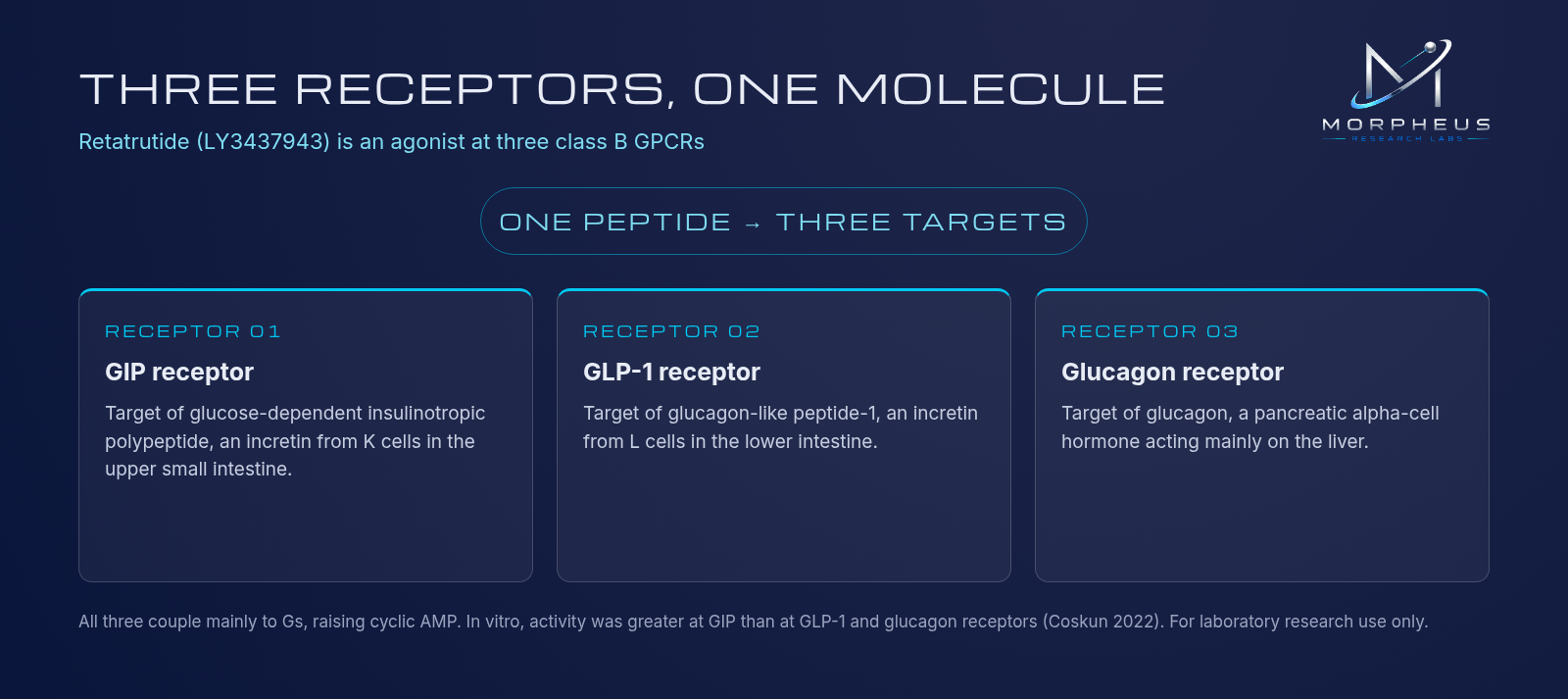
- The GIP receptor, the target of glucose-dependent insulinotropic polypeptide, an incretin hormone released from K cells in the upper small intestine.
- The GLP-1 receptor, the target of glucagon-like peptide-1, an incretin released from L cells in the lower intestine.
- The glucagon receptor, the target of glucagon, a pancreatic alpha-cell hormone that acts mainly on the liver.
All three receptors belong to the same receptor family and share structural features, and their natural ligands are related peptides. That shared ancestry is what makes it possible to design one peptide that binds all three. When activated, these receptors couple mainly to the Gs protein, raising intracellular cyclic AMP, though the downstream effects differ by tissue.
Physiologically, GIP and GLP-1 receptor signalling is studied in relation to glucose-dependent insulin secretion and to signalling in the brain and gut, while glucagon receptor signalling is studied in relation to hepatic glucose output, amino acid metabolism, liver lipid handling and energy expenditure. Combining all three in one molecule creates a research tool for asking how these pathways interact.
Relative potency
A single multi-receptor agonist is not equally potent at each receptor. In the 2022 Cell Metabolism paper by Coskun and colleagues, cell-based assays were used to characterize retatrutide's activity at each human receptor. The authors reported that in vitro it showed balanced activity at the glucagon and GLP-1 receptors but more activity at the GIP receptor. This balance is a deliberate design choice, and it is one reason the compound is studied as distinct from earlier single and dual agonists.
Molecular design
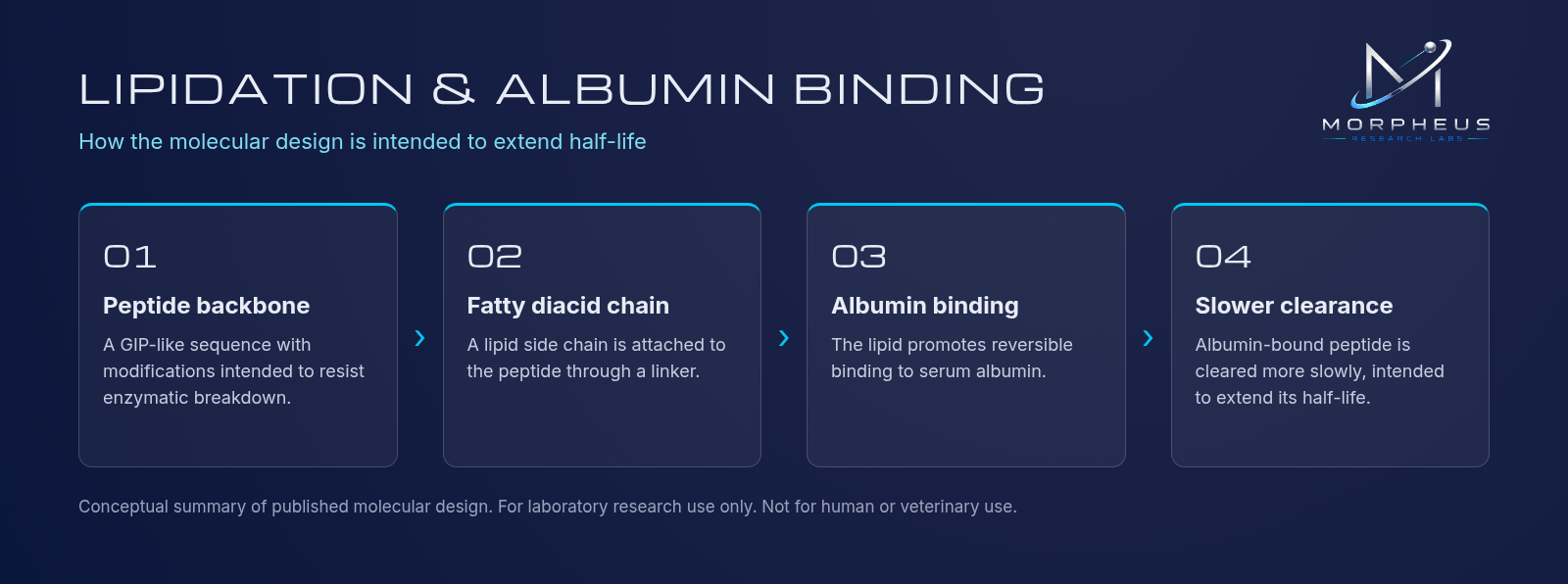
Retatrutide is a synthetic peptide built on a GIP-like backbone, and like other long-acting incretin-class peptides it includes sequence modifications intended to resist enzymatic breakdown. It carries a fatty diacid side chain attached through a linker. This lipid modification promotes reversible binding to serum albumin, which is intended to slow clearance and extend its half-life.
For laboratory work, the lipidation has practical consequences. Lipidated peptides can adsorb onto plastic and glass surfaces, can aggregate at high concentrations, and need HPLC conditions suited to their hydrophobicity. Mass spectrometry should confirm the expected mass of the modified peptide, not an unmodified sequence.
Preclinical studies
Coskun and colleagues reported the discovery and early characterization of LY3437943. In addition to receptor assays, they described studies in mouse models of diet-induced obesity, reporting effects on food intake, energy expenditure and body composition measures, with energy expenditure effects attributed in part to glucagon receptor activity. The paper also reported a phase 1 single ascending dose study, which assessed safety, tolerability and pharmacokinetics and reported its pharmacokinetic profile, including an extended half-life.
Clinical trial design
The phase 2 obesity study, published by Jastreboff and colleagues in the New England Journal of Medicine in 2023, was a randomized, double-blind, placebo-controlled trial. Its key design features:
- Participants: 338 adults with obesity, or with overweight plus at least one weight-related condition, without type 2 diabetes.
- Arms: placebo or one of several subcutaneous dose levels of a pharmaceutical-grade formulation, with some arms using dose escalation from a lower starting dose.
- Duration: 48 weeks.
- Endpoints: the primary endpoint was percentage change in body weight from baseline to 24 weeks, with the same measure at 48 weeks as a secondary endpoint. The authors reported dose-dependent differences from placebo on these endpoints. The most commonly reported adverse events were gastrointestinal.
Phase 3 programmes have since been under way. These trials studied a specific investigational drug product given under medical supervision. Their results do not describe research-market peptides and must not be treated as guidance for any personal use.
Why researchers study retatrutide
- Multi-receptor pharmacology. It allows comparison of triple agonism with single (GLP-1) and dual (GIP and GLP-1) agonists in receptor and cell assays.
- Glucagon receptor biology. It is a tool for studying how glucagon receptor activity contributes to hepatic and energy-expenditure signalling in models.
- Biased signalling. Researchers study whether multi-receptor agonists differ in downstream pathway activation, such as cyclic AMP versus β-arrestin recruitment.
- Analytical methods. Labs developing methods for lipidated peptides use it as a reference compound.
Study design considerations
Researchers using retatrutide in receptor assays should include native hormones as reference agonists for each receptor, use cell lines expressing a single receptor to separate activities, and report potency relative to those references. Because albumin binding affects apparent potency, assay buffers with and without albumin can give different results; report which was used. In approved animal studies, pair-fed controls help separate effects of food intake from other metabolic effects.
Characterization
Check that the certificate reports identity by mass spectrometry matching the lipidated peptide, HPLC purity with a chromatogram, and content per vial, since the compound is sold in several fill sizes. Morpheus Research lists Retatrutide 40mg, Reta 20mg and Reta 10mg.
Morpheus Research sends every lot to an independent third-party laboratory for identity and purity testing, separate from any manufacturer testing. As results come in, we publish the lot-specific certificate of analysis, so the lot number on your vial matches the certificate. Our BPC-157 wholesale guide explains how we test every lot.
Handling
Store lyophilized vials cold, dry and dark; let them reach room temperature before opening; reconstitute gently with a suitable sterile diluent such as bacteriostatic water; refrigerate solutions; avoid repeated freeze-thaw cycles; and use low-binding tubes for dilute solutions to limit surface adsorption.
Ordering
Order research quantities in the shop, or contact us through the contact page for wholesale pricing.
Frequently asked questions
Is retatrutide approved? No. It is an investigational compound in clinical development.
Which receptors does retatrutide act on? The GIP, GLP-1 and glucagon receptors, all class B G protein-coupled receptors.
Why is it lipidated? The fatty acid side chain promotes albumin binding, which is intended to slow clearance and extend its half-life.
How was the phase 2 trial designed? It was a 48-week randomized, double-blind, placebo-controlled trial in 338 adults, with percentage change in body weight at 24 weeks as the primary endpoint.
Do trial results apply to research peptides? No. They apply only to the investigational product studied under medical supervision.
Related reading
- Peptide COA Explained: How to Read a Certificate of Analysis
- How to Store Research Peptides: Lyophilized and Reconstituted Handling
- Peptide Reconstitution with Bacteriostatic Water: A Lab Handling Guide
- NAD+ in Longevity Research: What Published Studies Report
- SLU-PP-332 Research: ERR Agonists and the Exercise-Mimetic Question
References
- Coskun T, Urva S, Roell WC, et al. LY3437943, a novel triple glucagon, GIP, and GLP-1 receptor agonist for glycemic control and weight loss: from discovery to clinical proof of concept. Cell Metab. 2022;34(9):1234-1247.e9. PMID: 35985340.
- Jastreboff AM, Kaplan LM, Frías JP, et al. Triple-hormone-receptor agonist retatrutide for obesity — a phase 2 trial. N Engl J Med. 2023;389(6):514-526. PMID: 37366315.
Research use only. All products sold by Morpheus Research are intended strictly for laboratory research and are not for human or veterinary consumption. Nothing in this article is medical advice, and no statement here is intended to diagnose, treat, cure or prevent any condition. Study findings are reported as published and should not be read as evidence of effects in people.
For research use only. Not for human consumption.