NAD+ in Longevity Research: What Published Studies Report
NAD+ is a central metabolic coenzyme whose levels decline with age in many models. A review of the research on sirtuins, PARPs, CD38 and NAD+ precursors.
Nicotinamide adenine dinucleotide, or NAD+, is not a peptide, but it is one of the most researched molecules in ageing biology and is commonly stocked alongside research peptides. It is a coenzyme present in every living cell, essential to energy metabolism and to a family of enzymes involved in DNA repair and gene regulation. Over the past two decades, observations that NAD+ levels fall with age in many tissues and model organisms have made it a central topic in longevity research. This article summarizes what that research reports.
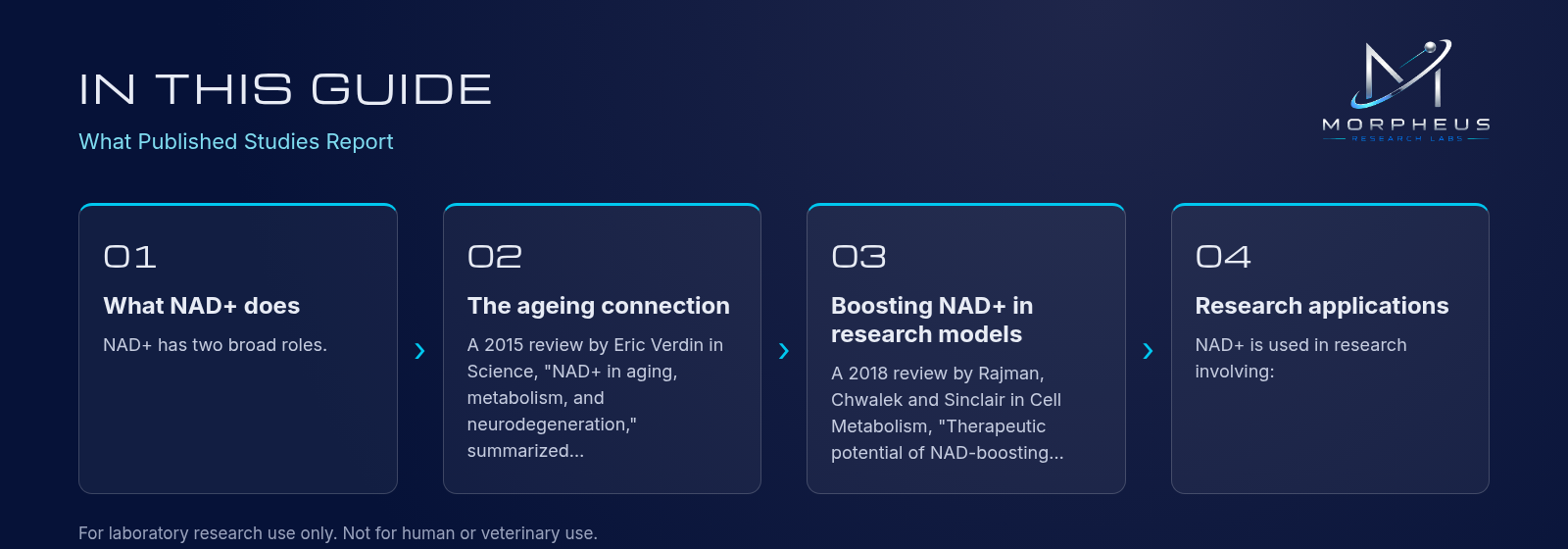
What NAD+ does
NAD+ has two broad roles.
Redox chemistry. NAD+ accepts electrons in metabolic reactions such as glycolysis and the citric acid cycle, becoming NADH. NADH then donates those electrons to the mitochondrial electron transport chain, which drives ATP production. In this role NAD+ is recycled rather than consumed.
Substrate for signalling enzymes. Several enzyme families consume NAD+ as a substrate:
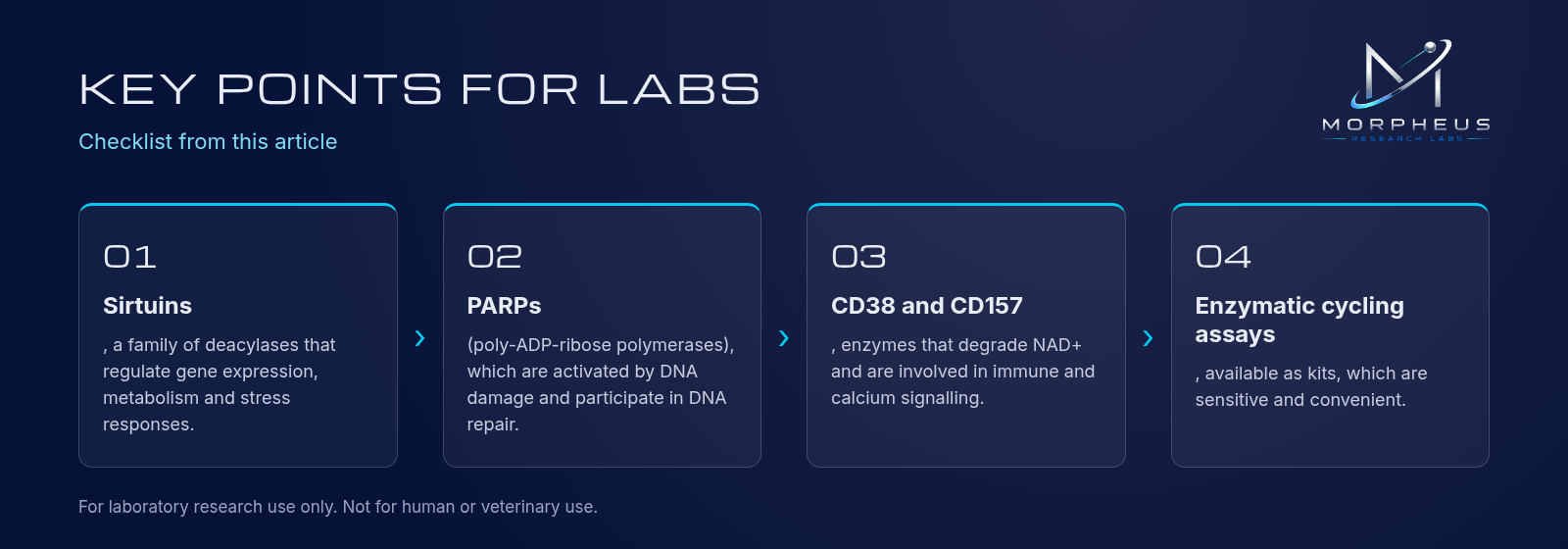
- Sirtuins, a family of deacylases that regulate gene expression, metabolism and stress responses.
- PARPs (poly-ADP-ribose polymerases), which are activated by DNA damage and participate in DNA repair.
- CD38 and CD157, enzymes that degrade NAD+ and are involved in immune and calcium signalling.
Because these enzymes consume NAD+, its availability can influence their activity.
The ageing connection
A 2015 review by Eric Verdin in Science, "NAD+ in aging, metabolism, and neurodegeneration," summarized evidence that NAD+ levels decline with age in multiple tissues in rodents and in some human tissue studies, and discussed how this decline might affect sirtuin activity, mitochondrial function and DNA repair. Proposed contributors to the decline include increased consumption by CD38, which research reports rises with age in some tissues, and increased PARP activity in response to accumulated DNA damage.
Boosting NAD+ in research models
A 2018 review by Rajman, Chwalek and Sinclair in Cell Metabolism, "Therapeutic potential of NAD-boosting molecules: the in vivo evidence," surveyed animal studies using NAD+ precursors such as nicotinamide riboside (NR) and nicotinamide mononucleotide (NMN). The authors summarized rodent studies reporting changes in measures of metabolic function, mitochondrial function and age-associated decline in various models. They also discussed early human studies of precursors, noting that these were mainly focused on safety and on whether NAD+ levels changed, and that larger controlled trials were needed.
Researchers should note the distinction between NAD+ itself and its precursors. Much of the in vivo literature uses NR or NMN, which cells convert to NAD+, rather than NAD+ directly. How NAD+ supplied externally is taken up by cells is itself an active research question, with studies reporting that extracellular NAD+ is often broken down to smaller precursors before uptake.
Research applications
NAD+ is used in research involving:
- Enzyme assays for sirtuins, PARPs and dehydrogenases.
- Cell culture studies of metabolic and mitochondrial function.
- Studies of NAD+ metabolism, uptake and degradation.
- Comparison with precursors such as NR and NMN.
Limits of the evidence
The animal literature is extensive, but translation to people is not established. Human studies of precursors have generally been small, short and focused on biomarkers. Reviews in this area consistently call for larger controlled trials. Any writing about NAD+ should keep that clearly in view.
Handling NAD+
NAD+ is sensitive to heat, moisture and pH. In the lab:
- Store the lyophilized powder cold and dry, protected from light.
- Equilibrate the vial to room temperature before opening.
- Prepare solutions fresh where possible; NAD+ is less stable in solution, particularly at alkaline pH.
- Keep solutions cold and avoid repeated freeze-thaw cycles.
- Record concentration, diluent and preparation date.
Sourcing
Morpheus Research supplies NAD+ 500mg for laboratory research, alongside bacteriostatic water. For volume orders, use the contact page.
NAD+ versus its precursors in research
Researchers choosing between NAD+ and its precursors should be clear about what each is suited for.
NAD+ itself is the right choice for enzyme assays, where a defined concentration of the coenzyme is needed in a cell-free system, and for studies of NAD+ uptake, degradation or extracellular signalling.
Precursors such as NR and NMN are more often used in cell and animal studies that aim to raise intracellular NAD+, because research suggests they enter cells more readily through specific transport routes or after conversion.
Nicotinamide and nicotinic acid, the older vitamin B3 forms, are also precursors, entering through different pathways.
Because these molecules can interconvert, studies need careful controls and, ideally, direct measurement of intracellular NAD+ and related metabolites rather than assumptions about what reached the cell.
Measuring NAD+ in samples
Measuring NAD+ accurately is technically demanding. NAD+ and NADH interconvert and degrade during sample processing, so extraction methods are chosen to preserve one form or the other: acid extraction preserves NAD+, while alkaline extraction preserves NADH. Common measurement approaches include:
- Enzymatic cycling assays, available as kits, which are sensitive and convenient.
- HPLC, which separates NAD+ from related compounds.
- LC-MS, which can measure NAD+ and many related metabolites together, giving a fuller picture of the NAD metabolome.
Report the extraction method, the assay and how quickly samples were processed, because these choices affect results.
Practical points for enzyme assays
In sirtuin and PARP assays, NAD+ is a substrate, so its concentration directly affects measured activity. Prepare NAD+ solutions fresh from powder on the day of use where possible, keep them on ice, and confirm concentration by absorbance if the work requires precision. Buffer pH matters: NAD+ is more stable in mildly acidic to neutral conditions. Include no-enzyme and no-substrate controls, and use the same lot of NAD+ across experiments that will be compared.
Common pitfalls in NAD+ research
A few problems recur in NAD+ studies. Measuring total NAD rather than NAD+ and NADH separately can hide shifts in redox balance. Tissue samples that sit at room temperature before freezing can lose NAD+ quickly, producing artificially low values. Comparing studies that used different precursors, doses and durations as though they were equivalent leads to confused conclusions. And extrapolating from cell culture, where precursor concentrations may be far higher than anything reached in tissues, needs caution. Clear methods sections that report sample handling, extraction and assay choice make results far easier to interpret.
Frequently asked questions
Is NAD+ a peptide? No. It is a dinucleotide coenzyme, though it is often studied and stocked alongside peptides.
Do NAD+ levels decline with age? Research reports declines in multiple tissues in rodents and in some human tissue studies.
What is the difference between NAD+, NR and NMN? NR and NMN are precursors that cells convert into NAD+. Much of the animal research uses precursors.
Has NAD+ been shown to slow ageing in people? No. Human studies to date are small and mostly measure biomarkers.
How should NAD+ be stored? Cold and dry as a powder. Solutions are less stable and are best prepared fresh.
Related reading
- Peptide COA Explained: How to Read a Certificate of Analysis
- How to Store Research Peptides: Lyophilized and Reconstituted Handling
- Peptide Reconstitution with Bacteriostatic Water: A Lab Handling Guide
- MOTS-c Research: The Mitochondrial-Derived Peptide Explained
- Retatrutide Research: The Triple Receptor Agonist and Its Published Trials
References
- Verdin E. NAD+ in aging, metabolism, and neurodegeneration. Science. 2015;350(6265):1208-1213. PMID: 26785480.
- Rajman L, Chwalek K, Sinclair DA. Therapeutic potential of NAD-boosting molecules: the in vivo evidence. Cell Metab. 2018;27(3):529-547. PMID: 29514064.
Research use only. All products sold by Morpheus Research are intended strictly for laboratory research and are not for human or veterinary consumption. Nothing in this article is medical advice, and no statement here is intended to diagnose, treat, cure or prevent any condition. Study findings are reported as published and should not be read as evidence of effects in people.
For research use only. Not for human consumption.