GHK-Cu Research: What the Copper Peptide Literature Reports
GHK-Cu is a copper-binding tripeptide first found in human plasma. A review of the published research, gene-expression data, chemistry and handling.
GHK-Cu is one of the oldest and most studied small peptides in the research market. It is a tripeptide, glycyl-L-histidyl-L-lysine, that binds copper(II) ions with high affinity. Since its discovery in the 1970s, it has been studied in cell culture, animal models and cosmetic science, and more recently through large-scale gene-expression analysis. This article summarizes what that literature reports, how the compound is characterized, and what labs should know about handling it.
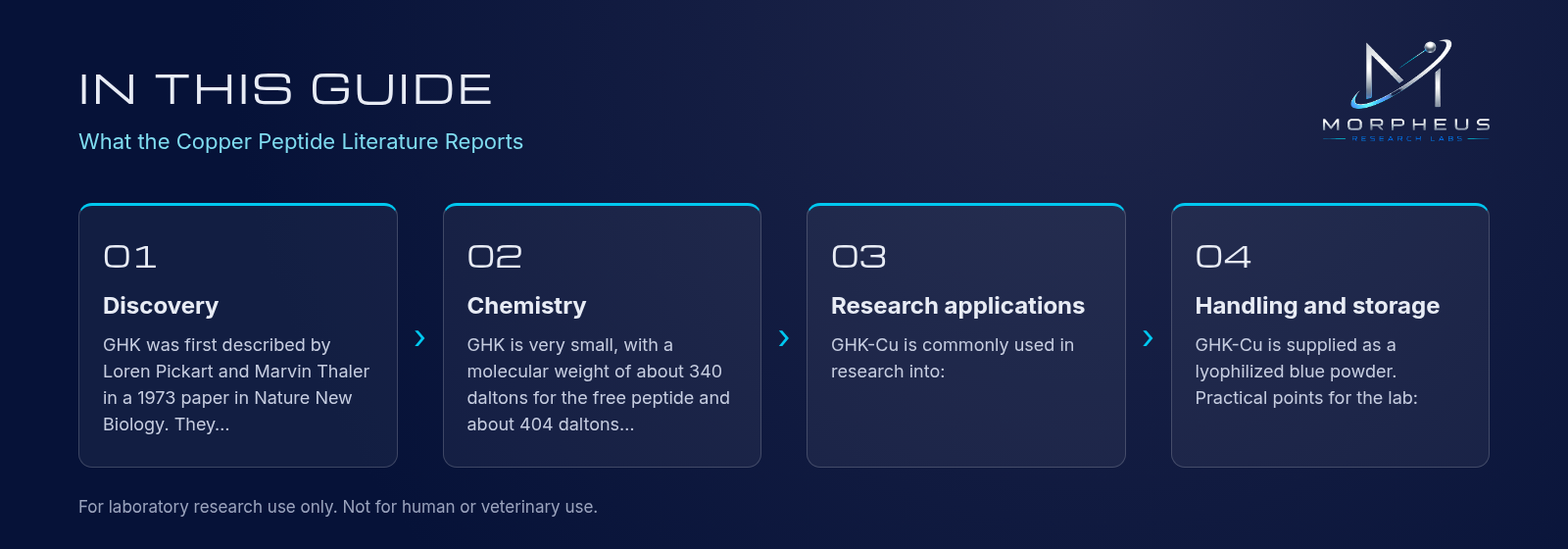
Discovery
GHK was first described by Loren Pickart and Marvin Thaler in a 1973 paper in Nature New Biology. They reported a tripeptide fraction in human serum that prolonged the survival of normal liver cells in culture and affected the growth of liver tumour cells in vitro. Later work established that GHK forms a complex with copper, and that this copper complex, GHK-Cu, accounts for much of the activity studied since.
GHK is present naturally in human plasma, saliva and urine. Published work reports that plasma levels are higher in younger people than in older people, which is one reason the peptide attracts interest in ageing research. That observation is correlational and does not by itself establish any causal role.
Chemistry
GHK is very small, with a molecular weight of about 340 daltons for the free peptide and about 404 daltons for the copper complex. The histidine imidazole ring, the glycine amino group and an amide nitrogen coordinate the copper ion. Because GHK binds copper tightly, it has been studied as a way copper might be transported to and from cells.
For buyers, two practical points follow. First, a COA for GHK-Cu should confirm the identity of the complex, not just the peptide. Second, the characteristic blue colour of the copper complex is expected, so a blue powder or solution is normal.
What the research reports
Cell culture and tissue models
Much early research examined GHK-Cu in fibroblast cultures and wound models in animals. Studies reported effects on markers associated with extracellular matrix remodelling, including collagen and glycosaminoglycan synthesis, in those models. This body of work underpins the compound's long use in cosmetic research, where topical formulations have been studied for skin-related measurements.
Gene-expression analysis
A 2018 review by Pickart and Margolina in the International Journal of Molecular Sciences, "Regenerative and protective actions of the GHK-Cu peptide in the light of the new gene data," discussed analyses using the Broad Institute's Connectivity Map. Those analyses compared gene-expression profiles from cultured human cells exposed to GHK with profiles from many other compounds. The authors reported that GHK was associated with changes in the expression of a large number of genes, including genes related to tissue remodelling, antioxidant responses and DNA repair pathways. Gene-expression associations in cell lines are a starting point for hypotheses; they do not show what happens in a living organism.
Limits of the evidence
The GHK-Cu literature is extensive but uneven. Much of it comes from a small number of authors, many studies are in vitro, and controlled clinical data for non-topical research is limited. Researchers should read primary studies carefully and note the model used in each.
Research applications
GHK-Cu is commonly used in research into:
- Extracellular matrix biology and fibroblast behaviour.
- Copper transport and metal-binding peptides.
- Gene-expression responses in cultured cells.
- Formulation science for topical delivery.
Handling and storage
GHK-Cu is supplied as a lyophilized blue powder. Practical points for the lab:
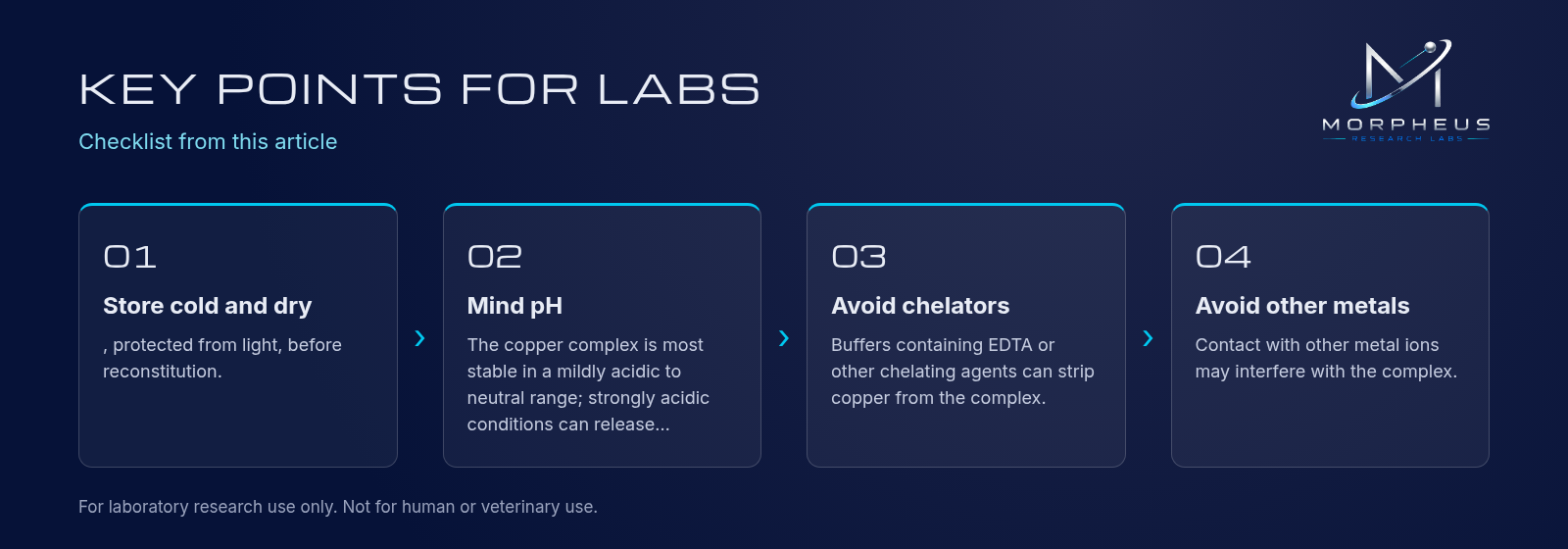
- Store cold and dry, protected from light, before reconstitution.
- Mind pH. The copper complex is most stable in a mildly acidic to neutral range; strongly acidic conditions can release copper.
- Avoid chelators. Buffers containing EDTA or other chelating agents can strip copper from the complex.
- Avoid other metals. Contact with other metal ions may interfere with the complex.
- Reconstitute gently with a suitable diluent, such as bacteriostatic water or a buffer compatible with your assay, then refrigerate.
Sourcing GHK-Cu
Because GHK-Cu is sold in large fill sizes and used widely in formulation research, quality varies. Check for:
- HPLC purity with a chromatogram.
- Mass spectrometry consistent with the copper complex.
- A lot number matching your vial.
- Independent third-party testing.
Morpheus Research supplies GHK-Cu 100mg for laboratory research. For larger quantities, use our contact page.
Confirming the copper complex
GHK-Cu presents an analytical question that most peptides do not: is the copper actually bound, and in the expected ratio? Free GHK and GHK-Cu have different masses, and a sample could contain a mix of the two, or copper that is not bound to the peptide at all.
Useful checks include:
- Mass spectrometry showing the mass of the copper complex, not just the free peptide. Under some ionization conditions copper can dissociate, so labs may report both species; the method notes should explain this.
- Colour. A blue powder or solution is expected. A white powder labelled GHK-Cu is a reason to ask questions.
- UV-visible spectroscopy, which some labs use to confirm the characteristic absorbance of the copper complex.
- Copper content, measured by elemental analysis in more detailed testing.
For most purchases, a certificate with HPLC purity and mass data consistent with the complex is sufficient. For formulation research, where the copper-to-peptide ratio matters, more detailed testing may be worth requesting.
Formulation research considerations
Much GHK-Cu research takes place in formulation science, where the question is how the complex behaves in creams, gels or solutions for topical research. Several factors are studied:
- pH range. Formulations outside a moderate pH range can destabilize the complex.
- Interactions with other ingredients. Chelating agents, some preservatives and strong reducing or oxidizing agents can disrupt the complex.
- Penetration. GHK-Cu is small and hydrophilic, which affects how it moves through skin models. Delivery systems such as liposomes have been studied.
- Stability over time. Accelerated stability testing at elevated temperatures is used to predict shelf life.
Researchers in this area typically run compatibility screens with the ingredients they plan to use before committing to a full formulation.
Large fill sizes and aliquoting
GHK-Cu is commonly supplied in larger fills than most peptides, such as 100 mg vials, because formulation work uses more material. Reconstituting a whole large vial at once is rarely ideal. Instead, many labs weigh out portions in a controlled environment, or reconstitute the vial and divide the solution into single-use aliquots for freezing. Either way, record the lot, the amount, the date and the storage location for each portion, and avoid repeated freeze-thaw cycles.
Frequently asked questions
What is GHK-Cu? A copper complex of the tripeptide glycyl-histidyl-lysine, first described in human plasma in 1973.
Why is GHK-Cu blue? The colour comes from the bound copper(II) ion and is expected.
What does the research show? Cell culture and animal studies report effects on markers of tissue remodelling, and gene-expression analyses report broad changes in cultured cells. These are preclinical findings.
Does buffer choice matter? Yes. Chelating agents and strongly acidic conditions can disrupt the copper complex.
How should GHK-Cu be stored? Cold, dry and away from light as a powder; refrigerated once reconstituted.
Related reading
- Peptide COA Explained: How to Read a Certificate of Analysis
- How to Store Research Peptides: Lyophilized and Reconstituted Handling
- Peptide Reconstitution with Bacteriostatic Water: A Lab Handling Guide
- Epitalon and Telomere Research: A Careful Look at the Evidence
- Research Peptides in Canada: A Practical Buyer's Guide for Labs
References
- Pickart L, Thaler MM. Tripeptide in human serum which prolongs survival of normal liver cells and stimulates growth in neoplastic liver. Nat New Biol. 1973;243(124):85-87. PMID: 4349963.
- Pickart L, Margolina A. Regenerative and protective actions of the GHK-Cu peptide in the light of the new gene data. Int J Mol Sci. 2018;19(7):1987. PMID: 29986520.
Research use only. All products sold by Morpheus Research are intended strictly for laboratory research and are not for human or veterinary consumption. Nothing in this article is medical advice, and no statement here is intended to diagnose, treat, cure or prevent any condition. Study findings are reported as published and should not be read as evidence of effects in people.
For research use only. Not for human consumption.