Epitalon and Telomere Research: A Careful Look at the Evidence
Epitalon (Epithalon) is a synthetic tetrapeptide studied in ageing research. What published work on telomerase and telomeres reported, and its limitations.

Epitalon, also spelled Epithalon, is a synthetic tetrapeptide that appears in almost every discussion of longevity peptides. Its reputation rests largely on reports that it influenced telomerase activity and telomere length in cultured cells. Those findings are genuinely interesting, but they come from a fairly narrow research base, and they are often repeated online with far more confidence than the evidence supports. This article explains what Epitalon is, what the published studies reported and how researchers should interpret them.
What Epitalon is
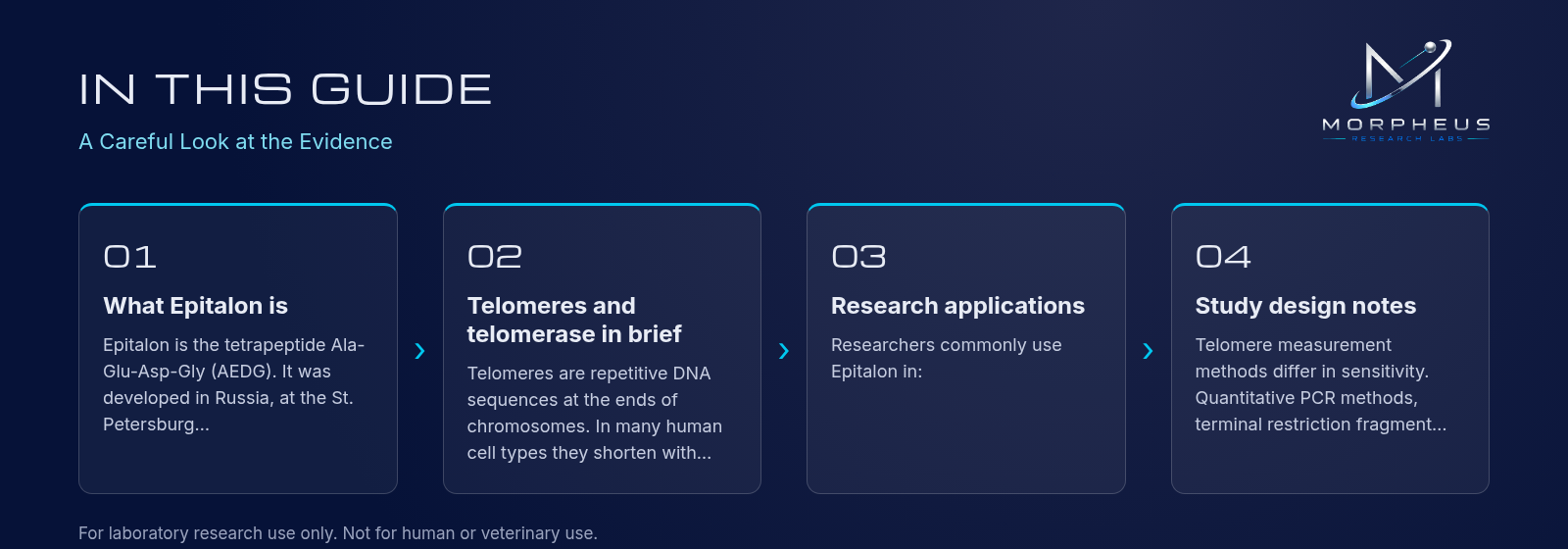
Epitalon is the tetrapeptide Ala-Glu-Asp-Gly (AEDG). It was developed in Russia, at the St. Petersburg Institute of Bioregulation and Gerontology, by researchers led by Vladimir Khavinson. It was designed as a synthetic analogue of epithalamin, a peptide extract from the pineal gland that the same group had studied earlier.
At four amino acids and a molecular weight of about 390 daltons, Epitalon is easy to synthesize and characterize. Its identity can be confirmed by mass spectrometry and its purity by HPLC, like any research peptide.
Telomeres and telomerase in brief
Telomeres are repetitive DNA sequences at the ends of chromosomes. In many human cell types they shorten with each cell division, and very short telomeres are associated with cellular senescence, a state in which cells stop dividing. Telomerase is the enzyme that can add telomeric repeats back. It is active in stem cells and many cancer cells but largely inactive in most adult somatic cells. Telomere attrition is listed among the hallmarks of ageing in the widely cited framework by López-Otín and colleagues.
This is why any compound reported to affect telomerase attracts attention. It is also why such reports need careful reading, since telomerase activation is a double-edged topic in cell biology.
What the research reported
Telomerase in cultured human cells
The most cited study is a 2003 paper by Khavinson, Bondarev and Butyugov in the Bulletin of Experimental Biology and Medicine, titled "Epithalon peptide induces telomerase activity and telomere elongation in human somatic cells." The authors reported that adding Epitalon to cultures of human fetal fibroblasts was associated with expression of the telomerase catalytic subunit, telomerase activity and telomere elongation in those cells. Later papers from the same group reported related findings in other cell types.
Animal studies
The Khavinson group and collaborators also published rodent studies reporting various outcomes, including measures of lifespan and tumour incidence in specific mouse and rat strains. Results in animal lifespan studies depend heavily on strain, housing and study design.
Limits of the evidence
Several caveats apply:
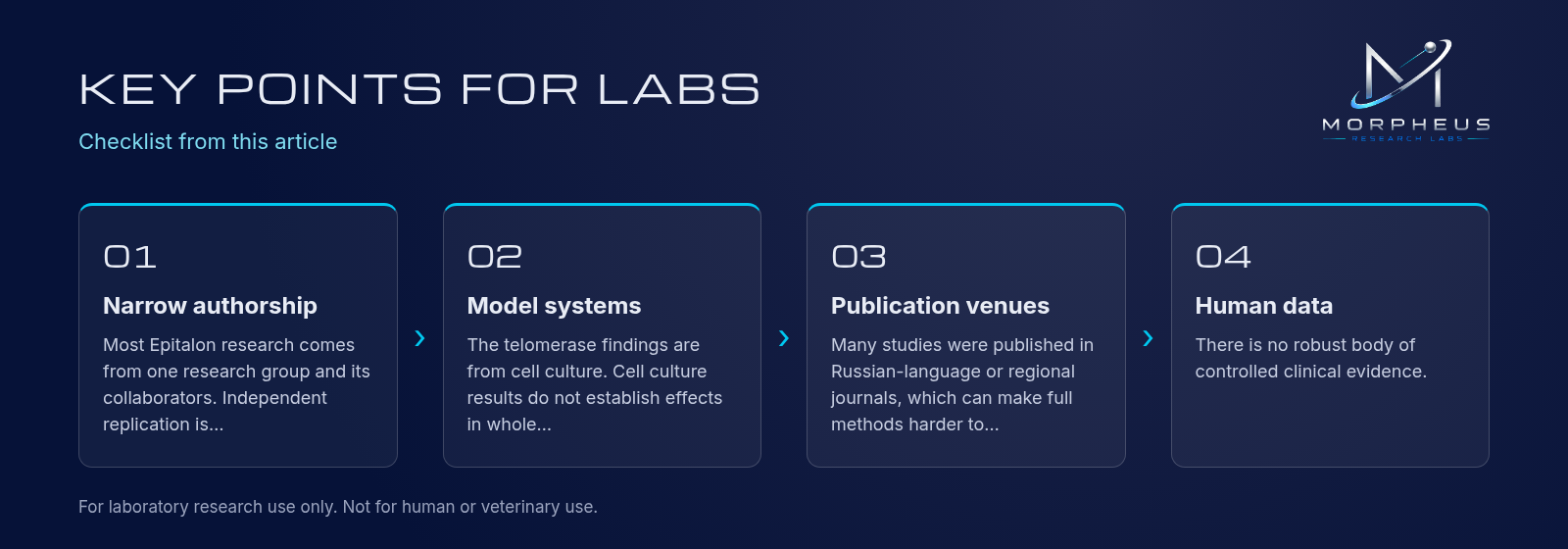
- Narrow authorship. Most Epitalon research comes from one research group and its collaborators. Independent replication is limited.
- Model systems. The telomerase findings are from cell culture. Cell culture results do not establish effects in whole organisms, let alone in people.
- Publication venues. Many studies were published in Russian-language or regional journals, which can make full methods harder to evaluate.
- Human data. There is no robust body of controlled clinical evidence.
None of this makes Epitalon uninteresting. It makes it a candidate for independent, well-controlled research rather than a settled topic.
Research applications
Researchers commonly use Epitalon in:
- Cell culture studies of telomerase expression and telomere length.
- Studies of cellular senescence markers.
- Comparative work alongside other short peptides from the same research tradition, such as Pinealon.
- Replication studies designed to test earlier published findings.
Study design notes
Telomere measurement methods differ in sensitivity. Quantitative PCR methods, terminal restriction fragment analysis and fluorescence in situ hybridization can produce different results. Researchers replicating earlier work should match methods where possible and include appropriate controls, such as cell populations at matched passage numbers.
Handling
Epitalon is supplied as a lyophilized powder. Store it cold, dry and away from light, equilibrate vials before opening, and reconstitute with a suitable sterile diluent such as bacteriostatic water according to your lab's procedures.
Sourcing
Morpheus Research supplies Epitalon 40mg for laboratory research. Ask for the batch certificate, and use the contact page for volume pricing.
Designing a replication study
Because most Epitalon findings come from one research tradition, a well-designed independent replication is one of the most useful contributions a lab can make. Key design points:
Match the original model where possible. The 2003 study used human fetal fibroblasts. Using a comparable primary cell type, at a comparable passage number, makes results easier to compare. Note the source and passage of every culture.
Measure telomerase and telomeres separately. Telomerase expression or activity and telomere length are different outcomes. Telomerase activity is often measured with a TRAP assay; expression of the catalytic subunit, TERT, can be measured by quantitative PCR or immunoblotting. Telomere length needs a separate method.
Choose telomere methods carefully. Quantitative PCR gives a relative measure and is fast but variable. Terminal restriction fragment analysis is slower but gives absolute lengths. Fluorescence methods can measure individual telomeres. Report which method was used and why.
Include controls. Vehicle-treated cells handled identically, untreated cells and, where possible, a positive control for telomerase expression.
Run enough time points. Telomere length changes slowly. Short experiments may not show changes even if telomerase is affected.
Pre-register or pre-specify. Decide primary outcomes in advance and report all results, including null findings.
Interpreting telomerase findings carefully
Telomerase activation is not a simple good-news story in cell biology. The enzyme is active in most cancer cells, where it supports their capacity to divide indefinitely. Any research reporting telomerase activation in normal cells therefore needs careful interpretation, including monitoring for changes in growth behaviour. Responsible writing about Epitalon notes this context rather than presenting telomerase activation as straightforwardly beneficial.
Related research compounds
Epitalon belongs to a group of short peptides developed in the same research tradition, sometimes called peptide bioregulators. Others studied by the same group include Pinealon, a tripeptide. These compounds share a common research history and similar evidence limitations. Researchers comparing them should apply the same standards of characterization and controls to each.
Frequently asked questions
What is Epitalon? A synthetic tetrapeptide, Ala-Glu-Asp-Gly, developed as an analogue of the pineal extract epithalamin.
Does Epitalon lengthen telomeres? A 2003 cell culture study reported telomerase activity and telomere elongation in human fetal fibroblasts. That is an in vitro finding from one research group, not evidence of an effect in people.
Has the research been independently replicated? Independent replication is limited. Most studies come from the original group and collaborators.
Is Epitalon approved for any use? It is sold as a research compound only in Canada.
How is Epitalon stored? As a lyophilized powder, cold, dry and protected from light.
Related reading
- Peptide COA Explained: How to Read a Certificate of Analysis
- How to Store Research Peptides: Lyophilized and Reconstituted Handling
- Peptide Reconstitution with Bacteriostatic Water: A Lab Handling Guide
- GHK-Cu Research: What the Copper Peptide Literature Reports
- MOTS-c Research: The Mitochondrial-Derived Peptide Explained
References
- Khavinson VK, Bondarev IE, Butyugov AA. Epithalon peptide induces telomerase activity and telomere elongation in human somatic cells. Bull Exp Biol Med. 2003;135(6):590-592. PMID: 12937682.
- López-Otín C, Blasco MA, Partridge L, Serrano M, Kroemer G. Hallmarks of aging: an expanding universe. Cell. 2023;186(2):243-278. PMID: 36599349.
Research use only. All products sold by Morpheus Research are intended strictly for laboratory research and are not for human or veterinary consumption. Nothing in this article is medical advice, and no statement here is intended to diagnose, treat, cure or prevent any condition. Study findings are reported as published and should not be read as evidence of effects in people.
For research use only. Not for human consumption.