CJC-1295 and Ipamorelin: What the Research Literature Reports
CJC-1295 (a GHRH analogue) and Ipamorelin (a ghrelin-receptor agonist): origins, published findings, blend characterization and lab handling.
CJC-1295 and Ipamorelin are two synthetic peptides that are frequently studied, and supplied, as a pair. Both have been investigated for their effects on growth hormone (GH) secretion, but they work through different receptors: CJC-1295 is an analogue of growth hormone-releasing hormone (GHRH), while Ipamorelin is a ghrelin-receptor agonist, part of the growth hormone secretagogue family. This article explains where each compound comes from, what the published literature reports, and what researchers should check when working with a blend.
Two different molecules
CJC-1295
CJC-1295 was developed by the Montreal company ConjuChem as a long-acting analogue of GHRH(1-29), the shortest fully active fragment of the natural hormone. Native GHRH is broken down within minutes, largely by the enzyme dipeptidyl peptidase-IV (DPP-IV). CJC-1295 carries four amino acid substitutions that improve resistance to that enzyme, plus a reactive maleimido group at the C-terminus, known as the drug affinity complex (DAC), that lets it bind covalently to circulating albumin. That albumin binding is what extends its half-life from minutes to days.
The research market uses the name loosely. Many products labelled "CJC-1295" are the tetrasubstituted GHRH(1-29) sequence without the DAC group, a peptide often called modified GRF(1-29) or "CJC-1295 no DAC." The two are different molecules with different masses and very different half-lives, and the published CJC-1295 studies below concern the DAC version. Check the stated sequence and the mass spectrometry result on the certificate to confirm which one you have.
Ipamorelin
Ipamorelin is a synthetic pentapeptide (Aib-His-D-2-Nal-D-Phe-Lys-NH2) developed at Novo Nordisk in the 1990s. It came out of a chemistry programme based on growth hormone-releasing peptides (GHRPs) such as GHRP-6, and it acts on the GH secretagogue receptor (GHS-R1a), the same receptor that the hormone ghrelin activates.
What the CJC-1295 literature reports
Discovery work in rats. Jetté and colleagues described the compound in Endocrinology in 2005. They synthesized three maleimido derivatives of GHRH(1-29), showed that albumin conjugates resisted DPP-IV and stayed active in cultured rat pituitary cells, and identified CJC-1295 as the best of the series. In rats it produced a roughly 4-fold larger GH response over two hours than unmodified GHRH(1-29).
Growth in a knockout mouse model. Alba and colleagues (American Journal of Physiology: Endocrinology and Metabolism, 2006) gave CJC-1295 to mice lacking the GHRH gene. Animals treated once daily for five weeks reached normal body weight and length, while less frequent administration was less effective. The authors also reported increased pituitary GH mRNA and signs of somatotroph proliferation.
Pharmacokinetic studies. Teichman and colleagues (Journal of Clinical Endocrinology & Metabolism, 2006) reported two randomized, placebo-controlled trials of the DAC compound run during its pharmaceutical development. They described sustained, dose-dependent rises in GH and IGF-I and an estimated half-life of about 6 to 8 days. A follow-up by Ionescu and Frohman in the same journal (2006) found that GH secretion still came in pulses after a single administration, with the frequency and size of pulses unchanged, while trough GH levels rose markedly. These were controlled pharmaceutical studies of a defined formulation, and their results should not be transferred to research-market peptides. Clinical development of CJC-1295 did not continue to approval.
What the Ipamorelin literature reports
The foundational paper is Raun and colleagues, "Ipamorelin, the first selective growth hormone secretagogue," in the European Journal of Endocrinology (1998). In rat pituitary cells, Ipamorelin released GH with potency and efficacy similar to GHRP-6, and antagonist experiments showed it acts through a GHRP-type receptor. The finding that drew attention was selectivity: in swine, GHRP-6 and GHRP-2 raised ACTH and cortisol, while Ipamorelin did not raise them beyond levels seen with GHRH, even at doses far above those needed for GH release. None of the compounds tested changed FSH, LH, prolactin or TSH.
Ipamorelin was later investigated as a pharmaceutical candidate for a gastrointestinal indication, because ghrelin-receptor stimulation affects gut motility. A phase 2, placebo-controlled study by Beck and colleagues (International Journal of Colorectal Disease, 2014) in patients recovering from bowel surgery found it well tolerated but reported no significant difference from placebo on the key efficacy measures. That is a useful reminder that strong preclinical selectivity does not guarantee a clinical result.
Why researchers study them together
The rationale for pairing the two comes from basic pituitary physiology. GHRH-receptor agonists and ghrelin-receptor agonists act on different receptors on the same somatotroph cells, and the endocrine literature has long described their combined effect on GH release in experimental settings as greater than either alone. A GHRH analogue plus a selective secretagogue is therefore a logical tool for studying how those two pathways interact. That is the hypothesis behind the format. Published controlled studies of the specific CJC-1295 and Ipamorelin combination are scarce, so a blend is best treated as a research material for asking that question, not as a format with an established advantage.
Characterizing a blend
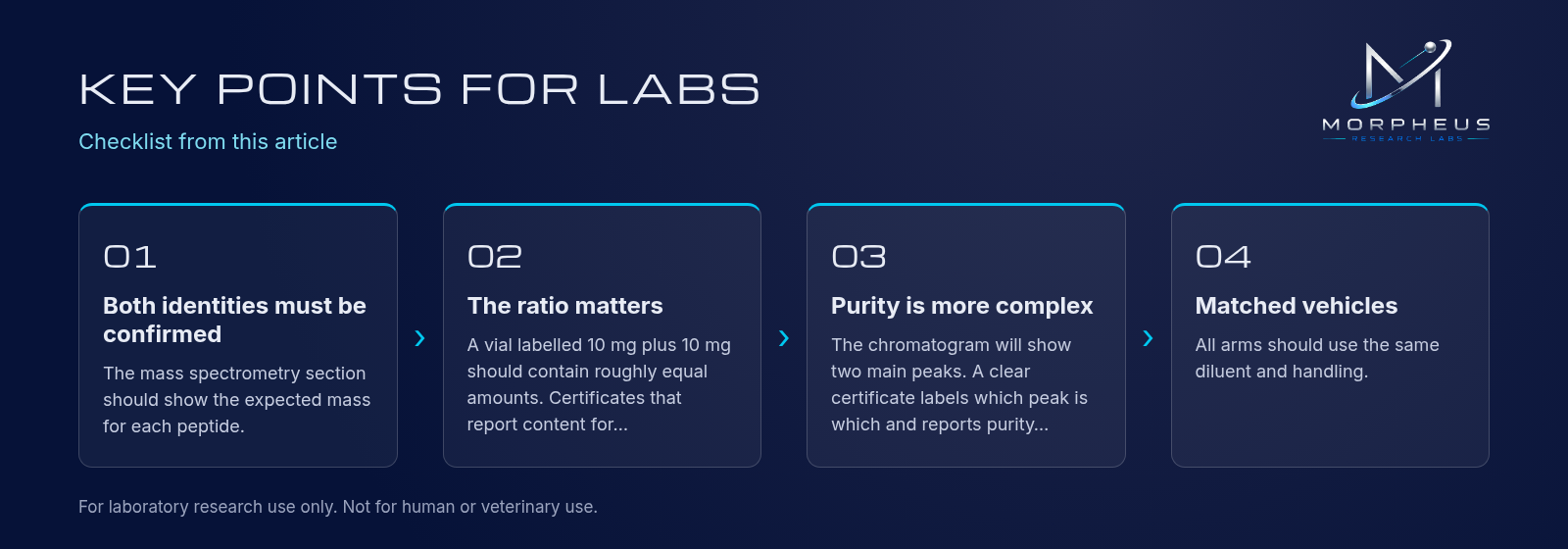
When two peptides share one vial:
- Both identities must be confirmed. The mass spectrometry section should show the expected mass for each peptide, and for CJC-1295 it should make clear whether the DAC group is present.
- The ratio matters. Certificates that report content for each component are much more useful than a single total figure.
- Purity is more complex. The chromatogram will show two main peaks. A clear certificate labels which peak is which and reports purity for each (see HPLC vs mass spectrometry).
Morpheus Research lists two formats: the CJC-1295/Ipamorelin blend 20mg and CJC/Ipamorelin 5mg. Ask us for the batch certificate for the lot you are ordering.
Study design considerations
If the research question is whether the combination differs from each component, a typical design includes four arms: vehicle control, CJC-1295 alone, Ipamorelin alone and the combination. The amounts of each peptide in the combination arm should match the single-compound arms, which a pre-mixed blend can only do if its certificate reports content for each component. Other points:
- Know which CJC-1295 you have. DAC and non-DAC versions have very different durations of action, so results from one cannot be read across to the other.
- Plan sampling around pulsatility. GH is released in pulses, so single time-point measurements are hard to interpret. The Ionescu and Frohman study used frequent sampling for this reason.
- Randomize, blind and pre-specify outcomes. Decide in advance which measures are primary, and code samples so outcome assessment is blind.
- Document the lot. Record the lot used in each experiment so results can be traced back to a specific certificate.
Handling and storage
Both peptides are supplied lyophilized. Typical laboratory practice is to store unopened vials cold, dry and protected from light, let a vial reach room temperature before opening, and reconstitute with a sterile diluent such as bacteriostatic water following the lab's own procedures. Reconstituted solutions are generally kept refrigerated and used within a set period, and repeated freeze-thaw cycles are avoided. The two peptides may degrade at different rates in solution, so preparing fresh solutions and keeping storage times short also limits drift in the ratio. Our storage and reconstitution guides cover this in more detail.
Responsible language
GH secretagogues are heavily discussed in fitness and anti-aging communities, and a lot of online content about them goes far beyond the evidence. Accurate wording ties each statement to a study: "in swine, Ipamorelin raised GH without raising ACTH or cortisol beyond GHRH levels." Wording such as "builds muscle," "burns fat" or "reverses aging" overstates the evidence and has no place in research-use material. For a wider look at this area, see our article on peptides in fitness and performance research.
Ordering
Browse blends and single compounds in the shop, or request volume pricing through the contact page.
Frequently asked questions
Are CJC-1295 and Ipamorelin the same kind of peptide? No. CJC-1295 is a GHRH analogue that acts on the GHRH receptor. Ipamorelin is a ghrelin-receptor (GHS-R1a) agonist.
What is the difference between CJC-1295 with and without DAC? The DAC version carries a reactive group that binds albumin and extends its half-life to days. The non-DAC version, often called modified GRF(1-29), shares the amino acid substitutions but lacks that group and is much shorter-acting.
Why is Ipamorelin called selective? In the original 1998 animal studies, it released GH without the ACTH and cortisol rises seen with older GHRPs.
Is there clinical evidence for the blend? Controlled studies of the combination are scarce. Each compound was studied on its own in pharmaceutical development, and neither was approved.
What should a blend COA show? Mass spectrometry identity for both peptides, purity for each peak, and ideally content for each component.
Related reading
- BPC-157 and TB-500 Blends: What the Research Literature Reports
- Peptide COA Explained: How to Read a Certificate of Analysis
- HPLC vs Mass Spectrometry: What Peptide Purity Testing Actually Shows
- How to Store Research Peptides: Lyophilized and Reconstituted Handling
- Research Peptides in Canada: A Practical Buyer's Guide for Labs
References
- Jetté L, Léger R, Thibaudeau K, et al. Human growth hormone-releasing factor (hGRF)1-29-albumin bioconjugates activate the GRF receptor on the anterior pituitary in rats: identification of CJC-1295 as a long-lasting GRF analog. Endocrinology. 2005;146(7):3052-3058. PMID: 15817669.
- Alba M, Fintini D, Sagazio A, et al. Once-daily administration of CJC-1295, a long-acting growth hormone-releasing hormone (GHRH) analog, normalizes growth in the GHRH knockout mouse. Am J Physiol Endocrinol Metab. 2006;291(6):E1290-E1294. PMID: 16822960.
- Teichman SL, Neale A, Lawrence B, et al. Prolonged stimulation of growth hormone (GH) and insulin-like growth factor I secretion by CJC-1295, a long-acting analog of GH-releasing hormone, in healthy adults. J Clin Endocrinol Metab. 2006;91(3):799-805. PMID: 16352683.
- Ionescu M, Frohman LA. Pulsatile secretion of growth hormone (GH) persists during continuous stimulation by CJC-1295, a long-acting GH-releasing hormone analog. J Clin Endocrinol Metab. 2006;91(12):4792-4797. PMID: 17018654.
- Raun K, Hansen BS, Johansen NL, et al. Ipamorelin, the first selective growth hormone secretagogue. Eur J Endocrinol. 1998;139(5):552-561. PMID: 9849822.
- Beck DE, Sweeney WB, McCarter MD; Ipamorelin 201 Study Group. Prospective, randomized, controlled, proof-of-concept study of the ghrelin mimetic ipamorelin for the management of postoperative ileus in bowel resection patients. Int J Colorectal Dis. 2014;29(12):1527-1534. PMID: 25331030.
Research use only. All products sold by Morpheus Research are intended strictly for laboratory research and are not for human or veterinary consumption. Nothing in this article is medical advice, and no statement here is intended to diagnose, treat, cure or prevent any condition. Study findings are reported as published and should not be read as evidence of effects in people.
For research use only. Not for human consumption.