Glutathione in Oxidative Stress Research: A Lab-Focused Overview
Glutathione is the main cellular thiol antioxidant. Its chemistry, the GSH/GSSG ratio, what published research reports about ageing, and lab handling tips.
Glutathione is the most abundant low-molecular-weight thiol in animal cells and a cornerstone of research into oxidative stress, detoxification and cellular ageing. It is a tripeptide, though an unusual one, and it is used across biochemistry, cell biology and toxicology labs both as a reagent and as a subject of study. This overview covers its chemistry, the measurements researchers rely on, what published research reports about its role in ageing models, and practical handling.
Structure
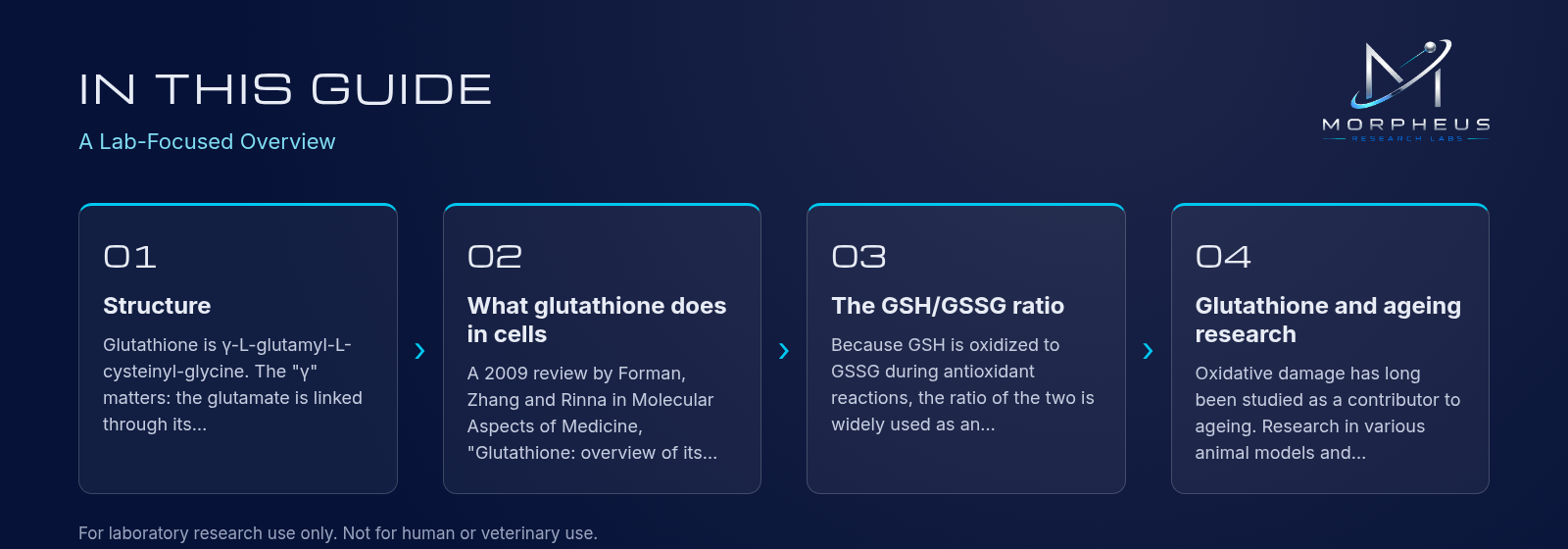
Glutathione is γ-L-glutamyl-L-cysteinyl-glycine. The "γ" matters: the glutamate is linked through its side-chain carboxyl group rather than the usual backbone carboxyl. This unusual bond makes glutathione resistant to most peptidases. The cysteine residue carries a free thiol (–SH) group, which is the source of glutathione's chemical reactivity.
Glutathione exists in two main forms:
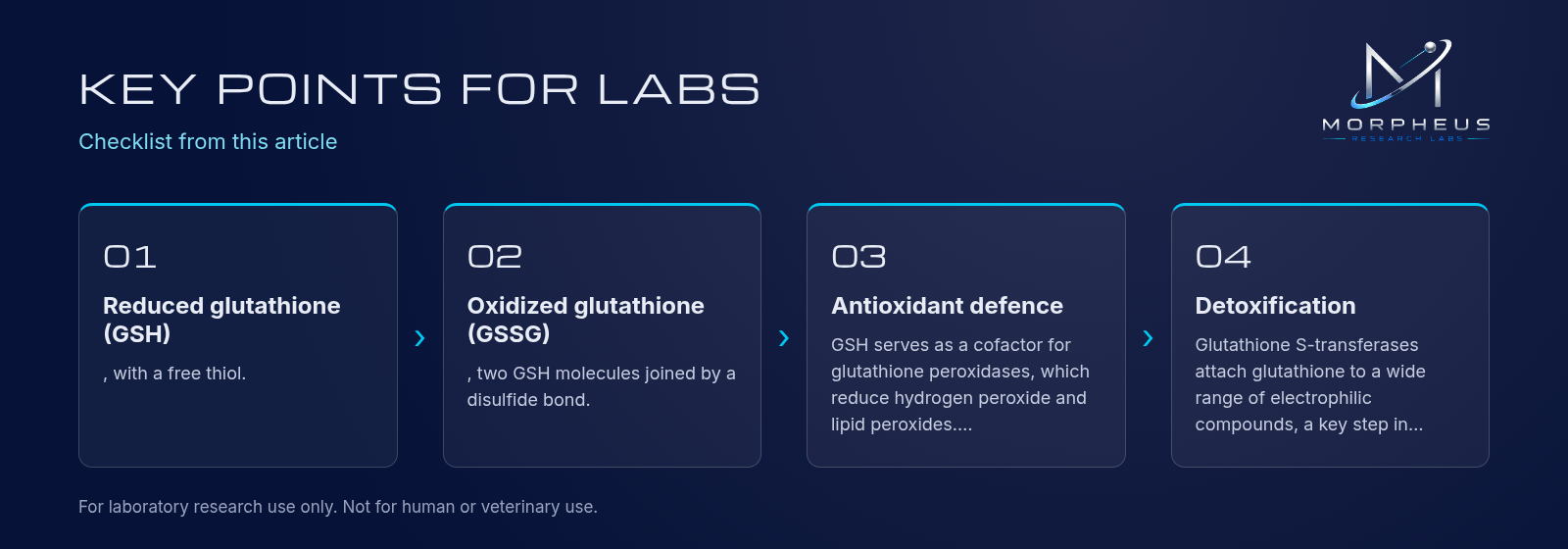
- Reduced glutathione (GSH), with a free thiol.
- Oxidized glutathione (GSSG), two GSH molecules joined by a disulfide bond.
What glutathione does in cells
A 2009 review by Forman, Zhang and Rinna in Molecular Aspects of Medicine, "Glutathione: overview of its protective roles, measurement, and biosynthesis," summarized its main functions:
- Antioxidant defence. GSH serves as a cofactor for glutathione peroxidases, which reduce hydrogen peroxide and lipid peroxides. GSSG produced in this process is recycled back to GSH by glutathione reductase using NADPH.
- Detoxification. Glutathione S-transferases attach glutathione to a wide range of electrophilic compounds, a key step in processing many xenobiotics.
- Redox signalling. Reversible glutathionylation of protein cysteine residues regulates protein function.
- Cysteine storage and transport.
Glutathione is synthesized inside cells in two ATP-dependent steps, by glutamate-cysteine ligase and glutathione synthetase. The first step is generally rate-limiting.
The GSH/GSSG ratio
Because GSH is oxidized to GSSG during antioxidant reactions, the ratio of the two is widely used as an indicator of cellular redox state. In healthy resting cells, most glutathione is in the reduced form. A shift toward GSSG is interpreted as oxidative stress. Measuring this ratio accurately is technically demanding, because GSH can oxidize during sample preparation. Methods typically include rapid processing and thiol-blocking agents such as N-ethylmaleimide.
Glutathione and ageing research
Oxidative damage has long been studied as a contributor to ageing. Research in various animal models and human tissue samples has reported age-associated changes in glutathione levels or redox ratios in some tissues, though results vary between tissues, species and methods. Modern frameworks, such as the hallmarks of ageing, treat oxidative damage as interconnected with mitochondrial dysfunction and other processes rather than as a single cause.
A recurring question in research is how supplied glutathione behaves. Because extracellular glutathione is broken down by γ-glutamyl transpeptidase on cell surfaces, many studies investigate precursors or modified forms instead. For cell culture work, researchers should consider whether they are measuring the effect of glutathione itself or its breakdown products.
Research applications
- Reagent in enzyme assays for glutathione peroxidase, reductase and S-transferases.
- Redox buffer in protein refolding.
- Cell culture studies of oxidative stress.
- Toxicology research on conjugation pathways.
- Comparisons with other antioxidant systems.
Handling glutathione
The free thiol that makes glutathione useful also makes it unstable in solution.
- Store powder cold and dry, sealed against moisture and air.
- Prepare solutions fresh whenever possible. GSH oxidizes in solution, especially at neutral to alkaline pH and in the presence of metal ions.
- Use degassed buffers for sensitive work, and consider adding a chelator such as EDTA to limit metal-catalysed oxidation.
- Keep solutions cold and limit exposure to air.
- Check form. Confirm whether your material is GSH or GSSG, since they behave differently.
Sourcing
Morpheus Research supplies Glutathione 600mg for laboratory research. Request the batch certificate with identity confirmation, and use the contact page for larger quantities.
Measuring glutathione accurately
Measuring glutathione is a classic example of how sample handling can determine results. GSH oxidizes readily once cells are disrupted, which can artificially lower the GSH/GSSG ratio. Common approaches include:
- Enzymatic recycling assays, which use glutathione reductase and a chromogenic reagent, often DTNB. They are sensitive and widely available as kits.
- HPLC with derivatization, where thiols are labelled with a fluorescent or UV-absorbing tag before separation.
- LC-MS, which can measure GSH, GSSG and related thiols with high specificity.
Whatever the method, two steps are key: block free thiols quickly, often with N-ethylmaleimide, to stop artificial oxidation, and acidify or deproteinize samples promptly. Report how quickly samples were processed and which blocking agent was used.
Glutathione as a laboratory reagent
Beyond being a research subject, glutathione is a standard reagent in many labs:
- Protein refolding. Mixtures of GSH and GSSG create a redox buffer that helps proteins form correct disulfide bonds during refolding.
- Affinity purification. Proteins tagged with glutathione S-transferase (GST) are purified on glutathione-coated resin and released with excess reduced glutathione.
- Enzyme assays. GSH is a substrate for glutathione S-transferases and peroxidases.
- Cell culture. It is sometimes added to media in studies of oxidative stress.
For reagent uses, consistent concentration matters more than anything else, so prepare solutions fresh and check pH, since dissolving GSH can lower the pH of a weak buffer.
Study design considerations
Researchers studying glutathione in cell culture should consider:
- Extracellular breakdown. As noted earlier, supplied glutathione can be broken down outside cells. Measuring intracellular levels directly is the only way to know whether treatment changed them.
- Precursors and inhibitors. N-acetylcysteine is commonly used to support synthesis, and buthionine sulfoximine to inhibit it. These tools help establish whether effects depend on glutathione.
- Oxygen levels. Standard culture conditions are more oxygen-rich than most tissues, which can affect baseline redox state.
Distinguishing glutathione forms and salts
Commercial glutathione is usually supplied as reduced glutathione (GSH), but oxidized glutathione (GSSG) is also sold for specific uses, such as redox buffers. The two are not interchangeable, and a certificate should state which form is supplied. Identity by mass spectrometry distinguishes them easily, since GSSG has roughly twice the mass of GSH minus two hydrogens. Purity by HPLC should also show whether a GSH sample already contains measurable GSSG, which indicates oxidation during manufacture or storage. For quantitative work, check the certificate before calculating concentrations, and store opened material tightly sealed to limit further oxidation.
Frequently asked questions
Is glutathione a peptide? Yes, a tripeptide of glutamate, cysteine and glycine, with an unusual γ-glutamyl bond.
What is the difference between GSH and GSSG? GSH is the reduced form with a free thiol; GSSG is the oxidized disulfide form.
Why is the GSH/GSSG ratio important? It is a widely used indicator of cellular redox state.
Why does glutathione degrade in solution? Its thiol group oxidizes, especially at higher pH and in the presence of metal ions.
How should glutathione be stored? As a dry powder, cold and sealed. Prepare solutions fresh.
Related reading
- Peptide COA Explained: How to Read a Certificate of Analysis
- How to Store Research Peptides: Lyophilized and Reconstituted Handling
- Peptide Reconstitution with Bacteriostatic Water: A Lab Handling Guide
- SLU-PP-332 Research: ERR Agonists and the Exercise-Mimetic Question
- KPV Tripeptide Research: The Alpha-MSH Fragment in the Literature
References
- Forman HJ, Zhang H, Rinna A. Glutathione: overview of its protective roles, measurement, and biosynthesis. Mol Aspects Med. 2009;30(1-2):1-12. PMID: 18796312.
- López-Otín C, Blasco MA, Partridge L, Serrano M, Kroemer G. Hallmarks of aging: an expanding universe. Cell. 2023;186(2):243-278. PMID: 36599349.
Research use only. All products sold by Morpheus Research are intended strictly for laboratory research and are not for human or veterinary consumption. Nothing in this article is medical advice, and no statement here is intended to diagnose, treat, cure or prevent any condition. Study findings are reported as published and should not be read as evidence of effects in people.
For research use only. Not for human consumption.